You've spent hours researching keywords, writing articles, and improving your website's SEO.
Your pages are getting impressions. Some are even ranking on Google.
But the traffic isn't bringing the results you expected.
Visitors arrive, look around, and leave without contacting your business or buying anything.
The problem might not be your keywords, backlinks, or website speed.
It could be that your content doesn't match what people actually want when they search.
That's where understanding What Is Search Intent becomes important.
Google tries to understand this purpose and show results that satisfy it.
For businesses investing in SEO, matching content to search intent can help attract more relevant visitors and create a better experience.
Let's explore how it works, the different types, and how to build content around what your audience really needs.
What Is Search Intent in SEO?
Every Google search starts with a purpose.
Some people want answers. Others are researching products, looking for a particular brand, or preparing to make a purchase.
For example, consider these three searches:
- "What is Google Ads?"
- "Best Google Ads agencies for small businesses"
- "Hire Google Ads specialist"
All three relate to Google Ads, but the users have different goals.
The first person wants to learn about advertising.
The second is comparing service providers.
The third may be ready to hire someone.
If you create the same type of content for all three searches, you may struggle to satisfy their different needs.
Understanding intent helps you decide what information each webpage should provide.
Why Is Search Intent Important for SEO?
A webpage can contain the right keywords but still fail to satisfy the query.
For example, someone searching for "how to create a Shopify store" expects practical instructions.
If Google shows them a service page that only promotes Shopify development services, that page may not provide what they need.
Matching intent helps businesses create content that serves the right audience.
Attract More Relevant Website Traffic
High search volume doesn't always mean high business value.
A keyword may attract thousands of visitors who have no interest in your products or services.
Another keyword may attract fewer visitors but produce more qualified inquiries.
Understanding intent helps you choose keywords that align with your goals.
Improve the User Experience
Visitors should find the information they expected when clicking a search result.
Someone searching for a product comparison should see useful differences, advantages, limitations, and pricing considerations.
They shouldn't have to search through unrelated promotional content.
Support Better Conversion Opportunities
Different users need different information before taking action.
A person researching SEO may benefit from an educational article.
Someone looking for an SEO agency may need service details, relevant experience, and a clear contact option.
The right content helps users move toward their next decision.
Build a Stronger Content Strategy
Instead of publishing random articles around popular keywords, you can organize website content around customer needs.
This creates a more useful SEO Content Strategy and reduces unnecessary overlap between pages.
The Four Types of Search Intent
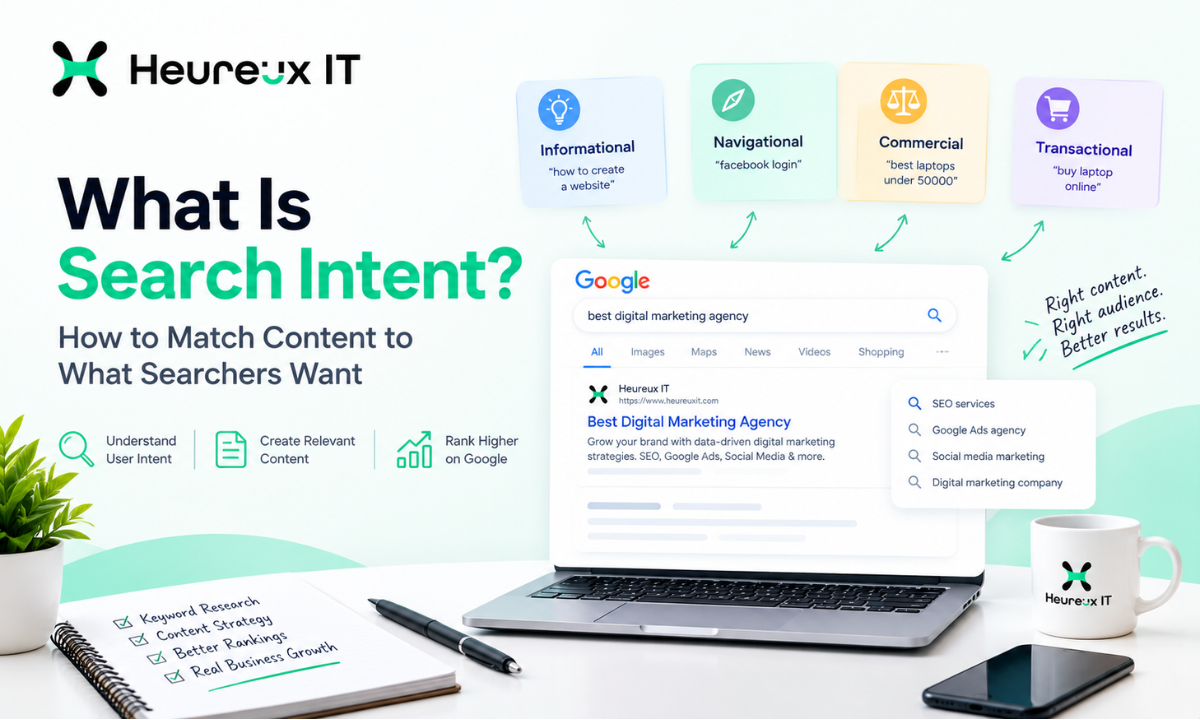
SEO professionals generally group searches into four main categories: informational, navigational, commercial, and transactional.
Each category represents a different user goal.
| Search Intent | User Goal | Example Keyword | Suitable Content |
|---|---|---|---|
| Informational | Learn something | How does SEO work? | Blog or educational guide |
| Navigational | Find a specific website | Google Search Console login | Official website or login page |
| Commercial | Compare options | Best SEO agencies | Comparison or buying guide |
| Transactional | Take action | Hire an SEO consultant | Service or conversion-focused page |
These categories are useful for planning, although some queries can contain more than one intent.
1. Informational Search Intent
Informational intent means someone wants to learn something or find an answer.
These searches often contain words such as "how," "what," "why," or "when."
Examples include:
- How does Google Ads work?
- What is Technical SEO?
- Why is my website loading slowly?
- How to improve website rankings?
The person may not be ready to purchase anything.
They are looking for helpful information.
How to optimize for informational intent
Create educational articles, tutorials, explanations, or practical guides.
Start with a direct answer, then explain the topic in more detail.
For example, an article about Technical SEO should explain the concept before discussing crawling, indexing, website speed, and other technical considerations.
Avoid turning every informational article into a sales pitch.
Readers are more likely to trust useful content that genuinely answers their questions.
2. Navigational Search Intent
Navigational intent occurs when someone wants to visit a particular website, brand, or webpage.
The user already knows the destination.
Examples include:
- YouTube login
- Google Analytics
- Shopify dashboard
- Heureux IT website
For these searches, people usually want to reach the relevant website quickly.
How to optimize for navigational intent
Make sure important branded pages are accessible and properly indexed.
Use clear page titles, recognizable branding, and straightforward navigation.
If someone searches for your business name, your official website should make it easy to find services, contact information, and other important pages.
Trying to attract another brand's navigational traffic usually provides little value if you cannot satisfy the user's intended destination.
3. Commercial Search Intent
Commercial intent means the user is researching options before making a decision.
They may already know what product or service they need but want to compare available choices.
Examples include:
- Best CRM software for startups
- Shopify vs WooCommerce
- Best SaaS SEO Agency
- Google Ads consultant reviews
These users are often closer to purchasing than people performing basic informational searches.
However, they still need more information before committing.
How to optimize for commercial intent
Create honest comparisons, reviews, buying guides, and detailed service evaluations.
For example, a comparison between Shopify and WooCommerce should explain differences in pricing, customization, hosting, and store management.
Include advantages and limitations rather than promoting one option without evidence.
Commercial content should help readers make informed decisions.
4. Transactional Search Intent
Transactional intent indicates that someone wants to complete an action.
That action might involve buying a product, booking an appointment, registering for a service, or starting a subscription.
Examples include:
- Buy running shoes online
- Book dental appointment
- Hire Google Ads expert
- Shopify subscription plans
These users generally expect a straightforward path to the next step.
How to optimize for transactional intent
Create relevant product pages, service pages, landing pages, or booking pages.
Explain the offer clearly.
Include important details such as product features, pricing where appropriate, availability, and how to proceed.
Make buttons, forms, and checkout processes easy to use.
Someone ready to buy shouldn't have to read a long educational article just to find the purchase option.
Can a Keyword Have More Than One Search Intent?
Yes. Some keywords have mixed intent because different users search for the same phrase with different expectations.
Consider "best running shoes for beginners."
One person may want advice about choosing shoes.
Another may want product comparisons.
Someone else may be ready to purchase a recommended pair.
Google might show a combination of buying guides, product pages, videos, and shopping results.
This is called mixed search intent.
When evaluating these keywords, look at the different content formats appearing in search results.
Your page should address the primary need while providing relevant supporting information.
Don't force unrelated topics into an article merely to cover multiple intents.
How to Identify Search Intent From Google Search Results
One of the most practical ways to understand a keyword is to examine the current search engine results page, often called the SERP.
Google's results provide clues about what users expect to find.
Here's how to analyze them.
1. Search Your Target Keyword
Enter the keyword into Google.
For example, search for "SEO pricing."
Look at the pages that appear near the top.
Are they pricing guides, agency service pages, calculators, or comparison articles?
The dominant content type provides a useful indication of intent.
2. Examine the Titles of Ranking Pages
Page titles can reveal the questions competitors are answering.
If most top-ranking results focus on costs, packages, and monthly retainers, users probably expect pricing information.
Creating a general article about the benefits of SEO may not satisfy that expectation.
3. Review Search Result Features
Google may display featured snippets, People Also Ask questions, videos, local listings, or product results.
These features can provide additional context.
For example, a search result containing maps and nearby businesses suggests that location matters to the query.
A page filled with tutorials may indicate informational intent.
4. Study Competing Content
Open relevant results and examine their structure.
Look at the questions they answer, examples they provide, and information users may still need.
Competitor analysis shouldn't mean copying their content.
Use it to understand expectations and identify opportunities to provide something more useful.
5. Consider the User's Real Goal
Finally, ask a simple question:
"What would someone want to accomplish after making this search?"
That answer should guide your page's purpose.
Remember that results can vary by location, device, personalization, and timing.
Review the market you actually want to target.
How to Match Content to Search Intent
Once you understand the intent, the next step is choosing the appropriate content format.
This is where many websites make mistakes.
They choose a valuable keyword and immediately write a blog post without considering whether a blog is what users want.
Choose the Right Page Type
An informational question usually works well as a guide or tutorial.
Commercial research may require a comparison article.
Transactional queries are often better served by product or service pages.
For example, "how does Meta advertising work?" is suitable for an educational article.
"Meta Ads management services" may require a service page explaining the offering, process, and next steps.
The page type should match the user's goal.
Answer the Main Question Early
Readers shouldn't need to scroll through several paragraphs before finding the basic answer.
A clear introduction makes content easier to understand.
For example, if your article explains keyword mapping, begin with a simple definition.
Then discuss how keyword mapping works, its benefits, and practical examples.
Provide Relevant Supporting Information
Users often have related questions.
A guide about website migration might also discuss backups, redirects, domain settings, and potential SEO risks.
These topics support the main subject.
Avoid adding sections that are unrelated to the reader's goal.
Use a Suitable Call to Action
Calls to action should reflect the stage of the customer journey.
An informational article might encourage readers to explore a related resource.
A commercial comparison may direct users toward detailed product information.
A transactional landing page should make the intended action straightforward.
Not every webpage needs the same call to action.
Want help turning this into results for your business?
Explore our SEO services →How Search Intent Improves Keyword Research
Keyword research helps businesses identify search terms, while intent analysis explains why people use them.
Both should work together.
Imagine you're planning content for a SaaS company offering project management software.
Your research identifies these keywords:
- What is project management software?
- Best project management software for teams
- Project management software pricing
- Buy project management software
The keywords share a topic, but they don't represent identical needs.
A strong SaaS SEO Strategy could use an educational article for the first query, a comparison guide for the second, and suitable product or pricing pages for the final queries.
This approach helps connect keyword selection with the customer journey.
Group Keywords by Meaning
Several keywords may express the same intention.
For example:
"What is search intent?"
"Search intent meaning"
"Search intent definition"
These terms can usually be answered by one comprehensive article.
Creating separate pages for every small wording variation may lead to overlapping content.
Map Keywords to the Right Pages
Keyword mapping means assigning relevant keywords or keyword groups to appropriate website pages.
For example, keywords related to SEO pricing should lead to content explaining costs.
This creates a clearer website structure.
How Search Intent Supports SaaS SEO Strategy
They may begin by learning about a problem.
Then they investigate software categories, compare products, and eventually request a demo or start a trial.
A SaaS website should provide useful content throughout this journey.
For example, a customer relationship management platform could publish an article explaining how to organize sales contacts.
It could also provide a comparison of CRM features and a dedicated product page showing its own capabilities.
These pages serve different purposes.
The educational article supports early research.
The comparison content supports evaluation.
The product page helps users understand whether the software fits their needs.
A strong content plan connects these stages without forcing every searcher toward an immediate purchase.
Common Search Intent SEO Mistakes
Even websites publishing high-quality content can struggle when their pages don't match user expectations.
Here are several mistakes worth avoiding.
Targeting Keywords Based Only on Search Volume
A high-volume keyword may attract people who aren't interested in your services.
Search volume should be considered alongside relevance and business value.
Choosing the Wrong Content Format
Trying to rank a general blog article for a highly transactional search can create a mismatch.
Likewise, a service page may not satisfy someone looking for detailed instructions.
Ignoring Current Search Results
Assuming intent based only on keyword wording can lead to inaccurate conclusions.
Always review the results appearing for your target queries.
Creating Multiple Pages With the Same Purpose
Similar pages may overlap in topic and compete for the same audience.
Consolidating closely related content can sometimes produce a clearer resource.
Writing for Keywords Instead of People
Repeating an exact keyword doesn't make an article more helpful.
Focus on answering the underlying question accurately.
Ignoring Changes in User Behavior
Search results and customer expectations can evolve.
Review important pages regularly to ensure they remain relevant.
How to Optimize Existing Content for Search Intent
You don't always need to publish a new article to improve your website.
Sometimes, updating existing content is the better option.
Start by reviewing pages that receive impressions but relatively few clicks.
Google Search Console can help identify these opportunities.
Look at the queries associated with each page.
Then compare those queries with what the content actually provides.
For example, a page may receive impressions for software pricing questions without including meaningful pricing information.
That suggests a possible mismatch.
Depending on the page's purpose, you could add relevant pricing details, explain the factors affecting cost, or create a dedicated pricing resource.
Also review the introduction, headings, examples, and content format.
Make sure the page satisfies the user's main question.
After publishing improvements, monitor results over time.
Don't assume every change in rankings is caused by search intent alone. Technical SEO, competition, content quality, and other factors also influence performance.
How Does Search Intent Work in AI-Powered Search?
AI-powered tools are changing how people express their questions.
Instead of searching only for short keyword phrases, users may ask detailed questions through ChatGPT, Gemini, Perplexity, and other AI assistants.
For example, someone might ask:
"Compare three affordable project management tools for a remote team and recommend which one is easiest to use."
That question combines research, comparison, and a request for a recommendation.
Some AI prompts also request the completion of tasks rather than information alone.
For businesses, the practical lesson remains similar.
Understand what people want and provide clear, useful information.
Create content that explains relevant features, limitations, comparisons, and real-world applications.
Well-organized content with direct answers can support both human readers and AI-assisted discovery.
However, satisfying intent doesn't guarantee that an AI platform will mention or cite your website.
Traditional SEO practices, content quality, and technical accessibility remain important.
How Heureux IT Approaches Search Intent Optimization
At Heureux IT, we believe effective SEO begins with understanding the people behind search queries.
Ranking for a popular keyword is only valuable when the website attracts an audience relevant to the business.
Our approach considers keyword research, competitor analysis, content quality, website structure, and search intent.
For example, a local service business may need location-specific service pages alongside educational content.
A SaaS company may need product comparisons, feature explanations, and resources that answer customer questions.
An eCommerce store may benefit from improved category pages, buying guides, and detailed product information.
Each business requires a different content strategy.
The goal is to connect relevant searches with pages that help people make informed decisions.
Rather than focusing only on traffic numbers, we consider how search visibility supports meaningful business outcomes.
Final Thoughts
Understanding What Is Search Intent helps businesses create content that better matches what people are searching for.
Not every visitor wants to purchase immediately.
Some need an explanation. Others want to compare options or reach a particular website.
A strong SEO strategy recognizes these differences.
Start by researching relevant keywords, reviewing Google search results, and identifying the goal behind each query.
Then choose a suitable content format and answer the user's questions clearly.
Keep your information accurate, useful, and easy to navigate.
At Heureux IT, we help businesses develop SEO strategies focused on relevant content, search visibility, and customer acquisition.
If your website attracts traffic but isn't reaching the right audience, explore Heureux IT's SEO Services to find opportunities to improve your content strategy.
Frequently Asked Questions
What Are the Four Types of Search Intent? +
The four main types are informational, navigational, commercial, and transactional. Each represents a different user goal, from learning about a topic to completing a purchase.
How Can You Identify Search Intent? +
Review the keyword's wording, analyze current Google search results, examine competing pages, and consider what users want to accomplish. Keyword research tools can also provide useful intent classifications.
Can a Keyword Have Multiple Search Intents? +
Yes. Some keywords have mixed intent because people use the same phrase for different purposes. Search results may therefore contain informational articles, comparisons, and product pages.
Does Matching Search Intent Guarantee Better Rankings? +
No. Matching intent improves the relevance and usefulness of content, but rankings also depend on factors such as content quality, competition, authority, technical SEO, and accessibility.
How Can Businesses Improve Existing Content for Search Intent? +
Review the keywords bringing impressions and clicks, compare your content with current search results, identify missing information, and update headings, explanations, examples, and page structure.
Is Search Intent Important for AI Search? +
Yes. AI-powered search tools interpret conversational questions that may combine different user goals. Clear and accurate content can help these systems understand information, although visibility and citations aren't guaranteed.
Heureux IT is a digital marketing agency specialising in Google Ads, Meta Ads and SEO. We help growing businesses turn paid and organic search into measurable revenue.