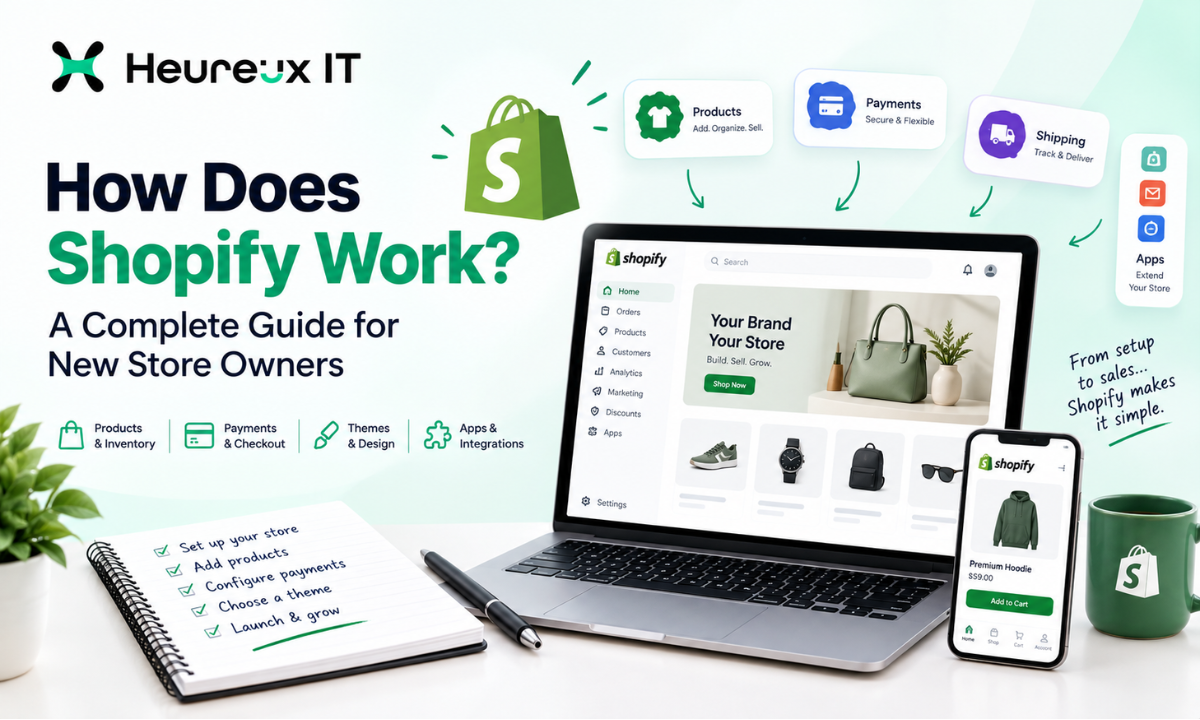
You've decided to start selling products online.
Maybe you already have a small business and want to reach more customers. Perhaps you're launching your first clothing brand, starting a dropshipping business, or moving your physical store online.
You start exploring eCommerce platforms and discover Shopify.
It promises to help you build an online store, accept payments, manage products, and process orders without developing everything from scratch.
But How Does Shopify Work, and what happens behind the scenes when someone purchases from your website?
Shopify is a hosted eCommerce platform that allows businesses to create online stores and manage sales from one central dashboard. It provides website-building tools, secure checkout functionality, product management, inventory tracking, and integrations with marketing and shipping services.
You don't need advanced programming knowledge to launch a basic Shopify store. However, building a store that provides a good customer experience and supports long-term business growth requires planning.
At Heureux IT, we help eCommerce businesses improve their websites through Shopify Development Services, store optimization, conversion tracking, and digital marketing.
This guide explains how the platform works, what happens when customers place orders, and which features matter most for new store owners.
What Is Shopify?
Shopify is a cloud-based commerce platform that helps businesses sell products and services online and in person. It combines an online storefront, checkout system, product catalog, inventory management, and order-processing tools.
Instead of buying separate hosting, installing eCommerce software, and creating your own checkout system, Shopify provides these essential functions within its platform.
Imagine you want to launch an online store selling handmade skincare products.
You need somewhere to display your products, explain their ingredients, accept payments, collect shipping information, and track customer orders.
Shopify allows you to manage these activities through one administrative dashboard.
The platform is used by different types of businesses, including independent retailers, growing eCommerce brands, dropshipping businesses, and established companies.
It's also suitable for businesses that sell in physical stores and want to connect their online and offline operations.
How Does Shopify Work for an Online Store?
Shopify connects your storefront, product information, checkout, inventory, and order management in one system.
Customers browse your website and select products. Shopify then handles the checkout process through a configured payment provider. Once an order is placed, the information appears in your admin dashboard so you can prepare and fulfill it.
Here's a simple example.
Imagine someone visits an online clothing store and finds a jacket they want to purchase.
They choose their size, add the jacket to their cart, and proceed to checkout.
The customer enters their contact and shipping information, chooses an available delivery method, and completes payment.
If the transaction succeeds, Shopify records the order and updates the relevant inventory according to the store's settings.
The store owner can then prepare the jacket for shipping, add tracking information, and update the order's fulfillment status.
The customer receives appropriate order notifications based on the store's notification settings.
This process brings several separate eCommerce operations together.
What Happens Behind the Scenes?
A Shopify store generally has four important parts.
The storefront is the website customers see. It includes your homepage, product collections, product details, cart, and other shopping pages.
The admin dashboard is where you manage products, orders, customers, inventory, discounts, and store settings.
The checkout system collects customer information and works with your configured payment methods.
The fulfillment process helps you manage what happens after a customer places an order.
These components work together to support the customer journey from product discovery to delivery.
How Shopify Hosting and Checkout Work
One of Shopify's biggest advantages is that it provides managed hosting alongside its commerce tools.
This means merchants normally don't need to purchase separate web hosting or maintain their own eCommerce server.
How Shopify Hosting Works
When you create a Shopify store, the platform provides an administrative environment and a myshopify.com address.
You can connect a custom domain so customers visit your business through a professional website address.
For example, a brand might use yourbrand.com instead of its default Shopify URL.
Shopify manages important infrastructure functions, including hosting and SSL support.
This makes routine technical administration simpler compared with managing a fully self-hosted eCommerce platform.
However, website performance still depends on your theme, images, apps, and custom code.
A Shopify website can still become slow if it contains unnecessary scripts or poorly optimized elements.
How Shopify Checkout Works
Shopify Checkout is the system customers use to complete purchases.
After adding products to their cart, shoppers can enter their contact information, select available shipping options, and pay using supported payment methods.
The exact options depend on your store's location, payment provider, plan, and configuration.
Shopify supports accelerated checkout experiences, including Shop Pay where available.
A well-configured checkout should help customers complete their purchases without unnecessary complications.
For example, unclear shipping fees or unavailable payment methods can discourage customers from completing their orders.
Before launching, test the entire checkout process to make sure it works as expected.
How Do Products and Inventory Work in Shopify?
Shopify allows merchants to create product listings and manage stock quantities through the admin dashboard.
Each product can have details such as a title, description, price, images, and shipping information.
Adding Products to Shopify
To create a product, you can open the Products section in your Shopify admin and add the relevant information.
For example, an online shoe store may create a product listing with:
- Product name and description
- Images showing different angles
- Selling price
- Available sizes and colors
- Stock quantities
- Shipping weight and other relevant information
Clear product information helps customers understand what they're purchasing.
It also supports product discoverability through search engines and connected shopping channels.
Understanding Product Variants
Variants allow a product to have different options.
A t-shirt might be available in multiple sizes and colors.
Rather than creating completely separate product pages for every combination, Shopify can manage these options within one product listing.
Variants can have their own prices, SKUs, and inventory quantities.
How Inventory Management Works
Shopify can track available stock for products and variants.
When tracked inventory is sold through a connected channel, stock quantities can be updated accordingly.
For businesses operating from multiple locations, Shopify can also manage inventory by location.
For example, a retailer may have products stored in two warehouses.
The available quantity at each location can affect how orders are fulfilled.
Correct inventory settings help reduce overselling and improve order management.
How Shopify Themes and Store Design Work
A Shopify theme controls the appearance and layout of your online store.
It determines how elements such as product images, navigation menus, category pages, buttons, and typography are displayed.
Shopify provides free and paid themes through its Theme Store.
Free Shopify Themes
Free themes can be a practical starting point for small businesses.
They provide essential eCommerce layouts and customization options without an additional theme purchase.
A new business with a limited budget may start with a free theme and improve its design as the store grows.
Premium Shopify Themes
Paid themes may offer different layouts, merchandising options, and design features.
However, purchasing a premium theme doesn't automatically improve conversion rates or search rankings.
The quality of your content, product presentation, and overall shopping experience still matters.
Custom Shopify Website Design
Some businesses need features or layouts that standard themes don't provide.
For example, a furniture retailer may require customized product information, advanced collection navigation, or a tailored mobile shopping experience.
Professional Shopify Web Development can help create these experiences through theme customization and appropriate integrations.
The goal should be a website that is easy to use, visually consistent, and aligned with customer needs.
How Do Shopify Apps Work?
Shopify apps extend the functionality of your online store.
They allow merchants to add features beyond the platform's built-in capabilities.
Apps are available through the Shopify App Store and may be developed by Shopify or third-party providers.
For example, a business may want customers to receive back-in-stock notifications when an unavailable product returns.
An appropriate app can provide that functionality.
Other apps support product reviews, subscriptions, email marketing, customer service, shipping, and analytics.
Do You Need Many Shopify Apps?
Not necessarily.
Every app should solve a clear business problem.
Installing too many apps can increase monthly costs, complicate store management, and sometimes affect website performance.
Before installing an app, review its pricing, permissions, compatibility, support, and actual functionality.
If a required feature already exists in Shopify, an additional app may be unnecessary.
For highly specialized requirements, a business may need a custom integration or application.
How Do Shopify Payments Work?
Shopify supports payment processing through Shopify Payments in eligible countries and approved third-party payment providers.
The availability of different methods depends on where the business operates.
Shopify Payments
Shopify Payments is the platform's integrated payment processing solution.
Where supported, eligible merchants can accept common payment methods without setting up a separate third-party payment gateway.
Merchants must still comply with payment provider requirements, and payment processing fees apply.
Third-Party Payment Providers
Businesses in countries where Shopify Payments isn't available can review supported external payment providers.
The appropriate provider depends on the store's business location, currency, and other requirements.
Additional transaction fees may apply depending on the plan and payment configuration.
When Does a Store Owner Receive Payment?
Customer payments are processed according to the selected provider's payout schedule.
The amount transferred may reflect processing fees, refunds, adjustments, or other applicable charges.
Store owners should review payout settings and transaction reports to understand the difference between sales revenue and money deposited into their bank account.
How Do Shopify Orders and Shipping Work?
When a customer completes checkout, Shopify creates an order record in the admin dashboard.
The order contains information needed to process the purchase.
This may include customer details, purchased items, quantities, payment status, and delivery information.
Managing Customer Orders
Merchants can review orders, update fulfillment status, issue eligible refunds, and manage other order-related actions.
For example, a store owner may receive an order for three products.
The order appears in the admin, allowing the business to prepare the items and arrange delivery.
Setting Up Shipping Rates
Shopify allows businesses to configure shipping zones and rates.
Depending on their requirements and available features, merchants may offer flat-rate shipping, free shipping, or carrier-calculated rates.
For example, a skincare brand might offer free shipping when a customer's cart reaches a particular value.
The business must configure the relevant shipping settings so eligible customers see the correct option at checkout.
Local Delivery and Pickup
Some businesses sell products within a specific geographic area.
Shopify supports local delivery and pickup workflows where configured.
For example, a bakery might accept online orders that customers collect from its physical location.
These settings should be tested to ensure customers receive accurate options.
Fulfillment and Order Tracking
Fulfillment refers to preparing and delivering purchased products.
Store owners may fulfill orders themselves, work with third-party logistics companies, or use compatible fulfillment services.
When tracking information is available and added correctly, customers can receive updates about their shipments.
How Does Shopify Work for Dropshipping?
Dropshipping is a business model where an online retailer sells products without keeping all the inventory itself.
When a customer places an order, a supplier handles product fulfillment.
Shopify can support dropshipping through compatible supplier integrations and applications.
For example, a store selling phone accessories may display products sourced from a supplier.
When someone purchases an accessory, the order information can be passed to the supplier through the configured workflow.
The supplier prepares and ships the item.
The retailer remains responsible for its customer experience, policies, and relevant business obligations.
Dropshipping reduces the need to maintain a traditional warehouse, but it doesn't eliminate customer support, supplier reliability, shipping, or profitability challenges.
Want help turning this into results for your business?
Explore our SEO services →Can You Sell Digital Products and Subscriptions on Shopify?
Yes. Shopify can support several business models beyond selling physical products.
Digital Products
Businesses may sell downloadable resources such as eBooks, templates, digital artwork, or software-related products.
Suitable apps and delivery systems can help provide access after purchase.
Subscription Products
Subscription businesses sell products or services on a recurring basis.
For example, a coffee company might offer monthly deliveries.
Shopify can support subscription selling through appropriate functionality and compatible subscription applications.
The exact setup depends on billing, fulfillment, and customer management requirements.
Wholesale and B2B Selling
Businesses may also use Shopify for wholesale operations.
More advanced B2B capabilities are available through eligible enterprise solutions, including Shopify Plus.
These can support requirements such as company accounts, wholesale catalogs, and business-specific pricing.
How Does Shopify Support Marketing and Sales?
Launching an online store is only the beginning.
Customers still need to discover the website and find products worth purchasing.
Shopify provides marketing and reporting tools, along with integrations for external advertising platforms.
Shopify SEO
Shopify websites can be optimized for organic search.
Important activities include writing useful product descriptions, organizing collections, optimizing images, and improving page titles.
A clear website structure helps customers and search engines navigate your store.
However, simply launching on Shopify doesn't guarantee rankings.
Search visibility depends on content quality, relevance, competition, and technical implementation.
Google Shopping Ads
Shopify stores can connect product information to Google Merchant Center using compatible integrations.
Professional Google Shopping Ads Management can help businesses optimize product feeds, improve campaign structure, and reach relevant shoppers.
This allows eligible products to participate in supported Google shopping experiences and advertising campaigns.
Accurate product titles, prices, availability, images, and shipping information are important for product feed quality.
Meta Ads
Businesses can promote products using Facebook and Instagram advertising.
Depending on the integration, merchants may connect product catalogs and measurement tools.
Accurate tracking is important when evaluating purchases, revenue, and advertising efficiency.
Email Marketing
Email marketing can help stores communicate with customers who have provided the appropriate permissions.
Examples include welcome messages, promotional campaigns, and abandoned-checkout reminders.
Shopify Analytics
Shopify provides reports that help businesses understand store performance.
Merchants can review information such as orders, sales, customer activity, and selected marketing results.
For more detailed advertising analysis, businesses may also configure Google Analytics 4 and other measurement tools.
How Much Does Shopify Cost?
Shopify uses subscription plans with different features and capabilities.
The cost depends on the chosen plan, billing arrangement, business location, and additional services.
Its main plan categories include Basic, Grow, Advanced, and Plus.
Basic is generally suitable for new merchants who need essential online selling functionality.
Grow provides additional capabilities for businesses with expanding operational needs.
Advanced is designed for merchants requiring more sophisticated commerce features.
Shopify Plus serves larger businesses with complex or enterprise-level requirements.
Your total budget may also include domain registration, paid themes, applications, payment processing, custom development, and marketing.
Because pricing and plan features can change, check Shopify's official pricing page before making a decision.
What Are the Advantages and Limitations of Shopify?
Shopify offers several advantages, but it isn't ideal for every business.
Advantages
Managed infrastructure: Merchants don't need to administer a traditional eCommerce server.
Centralized management: Products, orders, inventory, and many store settings are managed through one dashboard.
Theme customization: Businesses can create branded storefronts using themes and development tools.
App ecosystem: Integrations can extend functionality for different business needs.
Multiple sales channels: Supported integrations can connect online, retail, and other commerce activities.
Limitations
Ongoing costs: Subscriptions, applications, and processing fees can increase operating expenses.
App dependence: Some specialized features require third-party applications.
Customization complexity: Advanced requirements may involve custom development.
Platform restrictions: Certain checkout, backend, and enterprise features depend on plan eligibility or platform capabilities.
No automatic sales: Businesses still need competitive products, effective marketing, and good customer service.
The right platform should support your operational needs without creating unnecessary technical or financial complications.
Shopify Web Development: When You Need a Pro
Many store owners can launch a basic Shopify website using a ready-made theme.
However, professional development becomes more useful when a store needs custom functionality, advanced integrations, or major design improvements.
A Shopify Developer can help businesses create a shopping experience that fits their requirements rather than forcing every process into standard templates.
When Should You Hire a Shopify Developer?
You may need professional support when:
- Your store needs a custom design or theme modifications.
- Product pages require specialized features or advanced product information.
- You need integrations with external systems.
- Your website loads slowly or contains technical problems.
- You're migrating products and customers from another eCommerce platform.
- Your checkout, shipping, or tax configuration needs specialized attention.
- Your business requires custom applications or automation.
For example, a retailer managing inventory across multiple systems may need a customized integration to keep product availability accurate.
Similarly, an eCommerce brand running several advertising campaigns may need reliable purchase tracking and product feed configuration.
Professional Shopify eCommerce Development can help address these requirements while keeping the customer experience in mind.
What Does a Shopify Development Company Do?
A Shopify development company can support the technical and design requirements of an online store.
Depending on the project, services may include theme customization, product catalog configuration, integration development, performance optimization, migration, and ongoing maintenance.
A good development partner should understand not just how the platform works but also how customers interact with an eCommerce website.
Common Shopify Mistakes New Store Owners Should Avoid
Starting an online store is easier when you understand the issues that can affect its performance.
Choosing a Theme Only for Its Appearance
A beautiful theme may not be the best choice for every product catalog.
Consider navigation, mobile usability, product presentation, and compatibility with your requirements.
Using Low-Quality Product Images
Customers rely on images when evaluating products online.
Blurry images or missing product angles can make purchasing decisions more difficult.
Ignoring Shipping Settings
Unexpected delivery fees and unavailable shipping options can create checkout problems.
Configure your shipping rules carefully and test different customer locations.
Installing Too Many Applications
Unnecessary apps can increase expenses and create performance or compatibility issues.
Install only the tools your business needs.
Launching Without Testing
A store may look ready but still have problems with payment methods, discounts, inventory, or order notifications.
Test the entire purchase process before accepting live orders.
Forgetting Conversion Tracking
Without reliable measurement, it becomes harder to identify which marketing activities generate sales.
Make sure important events are configured and tested.
How Can You Tell Whether Your Shopify Store Is Performing Well?
A successful Shopify store isn't measured only by how many people visit it.
You also need to understand whether visitors purchase products and whether those sales are profitable.
Important metrics include:
Conversion Rate: The percentage of sessions resulting in orders, based on the reporting definition used.
Average Order Value: The average amount customers spend per order.
Revenue: Sales generated during a selected period.
Customer Acquisition Cost: The amount spent acquiring customers.
Return on Ad Spend: Revenue attributed to advertising divided by advertising spend.
Cart and Checkout Behavior: Information that helps identify where customers leave the purchasing process.
Repeat Customer Rate: The proportion of customers who return to make additional purchases.
For example, a store might generate strong traffic but have a low conversion rate.
That doesn't necessarily mean it needs more advertising.
It may need better product pages, more transparent shipping information, or a clearer checkout experience.
Regular performance reviews help merchants decide where improvements could make the greatest difference.
Why Choose Heureux IT for Shopify Development Services?
At Heureux IT, we understand that creating an online store involves more than selecting a theme and uploading products.
Your website should help customers find relevant products, understand what they're buying, and complete purchases easily.
Our approach to Shopify Website Development considers store structure, responsive design, product presentation, Technical SEO, and Conversion Tracking.
We also understand the relationship between eCommerce development and digital marketing.
For example, a store running Google Shopping campaigns needs accurate product information and a properly configured product feed.
A business investing in Meta Ads needs reliable conversion measurement to evaluate campaign performance.
And a store attracting organic traffic needs useful collection pages, descriptive product content, and clear navigation.
Connecting these areas helps create a stronger foundation for online selling.
Whether you're launching a new store, improving an existing one, or planning a migration, the goal is to develop a website that supports your business requirements.
Final Thoughts
Understanding How Does Shopify Work helps new store owners make better decisions about their online business.
Shopify brings together website design, product management, inventory, payments, shipping, and order processing within one platform.
It also supports different selling models, including physical products, digital products, subscriptions, and eligible wholesale operations.
However, the platform itself doesn't guarantee business success.
Your products, pricing, customer experience, website quality, and marketing strategy all influence results.
Start by understanding your business requirements.
Choose an appropriate theme, organize your product information, configure payments and shipping, and test the complete purchasing journey.
As your store grows, evaluate whether custom development or additional integrations would improve its operation.
At Heureux IT, we help businesses build and optimize Shopify websites with a focus on usability, search visibility, and measurable marketing performance.
Explore Heureux IT's Shopify Development Services to discuss your store requirements and opportunities for growth.
Frequently Asked Questions
How Does Shopify Work for Beginners? +
Shopify provides a hosted platform where beginners can create an online store, add products, customize a theme, configure payments, and manage orders. A basic store can be created without advanced coding knowledge.
Is Shopify Free to Use? +
Shopify provides trial offers, but ongoing access to a fully operational store generally requires a paid subscription. Pricing and promotional offers vary.
Do You Need a Developer to Use Shopify? +
No. Many businesses can launch basic stores using Shopify themes and built-in features. Developers are useful for advanced customization, integrations, and complex requirements.
How Do Customers Pay on Shopify? +
Customers pay through the store's configured checkout and payment methods. Merchants can use Shopify Payments where available or supported third-party payment providers.
Does Shopify Handle Shipping? +
Shopify provides tools for configuring shipping rates, delivery options, fulfillment, and tracking. Merchants remain responsible for arranging fulfillment unless they use a third-party service.
Can You Sell Digital Products on Shopify? +
Yes. Shopify supports digital product selling through suitable configurations and applications that can provide customers with access to purchased files or digital services.
Is Shopify Good for Small Businesses? +
Shopify can be suitable for small businesses that want managed hosting, product management, checkout, and order-processing tools. Costs and functionality should be evaluated against the business's needs.
Can Shopify Connect to Google Ads and Meta Ads? +
Yes. Shopify can connect with Google and Meta through supported sales channels, integrations, and tracking tools. Proper configuration is important for reliable product data and conversion measurement.
What Are Shopify Themes and Apps? +
Themes control how the storefront looks and how content is displayed. Apps extend store functionality with tools for marketing, shipping, reviews, subscriptions, and other business requirements.
When Should You Hire a Shopify Developer? +
Consider hiring a developer when your store needs custom design, advanced features, specialized integrations, migration assistance, or technical improvements beyond the capabilities of standard themes.
Heureux IT is a digital marketing agency specialising in Google Ads, Meta Ads and SEO. We help growing businesses turn paid and organic search into measurable revenue.