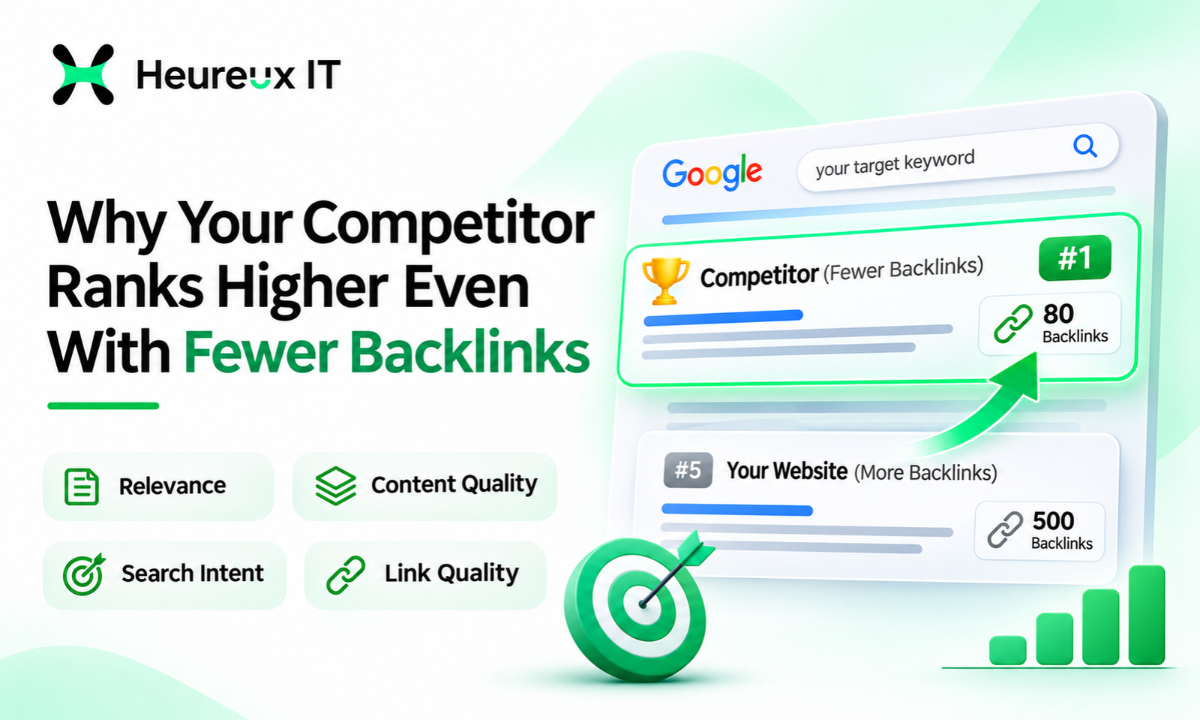
You've spent months building backlinks, publishing articles, and improving your website.
Yet when you search Google for your most important business keywords, a competitor appears above you.
You check their backlink profile and discover something surprising.
They have fewer backlinks than your website.
So why are they ranking higher?
It's a common question among business owners who invest in SEO but struggle to achieve the search visibility they expect.
Backlinks remain important because they help search engines discover content and evaluate relationships between websites.
However, Google doesn't rank pages simply by counting the number of links pointing to them.
A competitor with fewer backlinks may have more relevant content, stronger linking websites, better internal links, or a page that matches the searcher's needs more closely.
Technical accessibility, website structure, and overall trust also matter.
Understanding Why Competitors Rank Higher on Google requires looking beyond backlink totals.
In this guide, we'll explore the factors that can help websites outrank competitors with larger backlink profiles, explain how to conduct an SEO competitor analysis, and share practical steps to improve your search performance.
Do More Backlinks Always Mean Higher Google Rankings?
No. Having more backlinks doesn't guarantee higher rankings.
A backlink is a link from one website to another.
Google uses links as one of several signals to understand pages and determine their relevance.
However, backlinks differ in quality, context, and usefulness.
For example, a business website might have 500 backlinks from unrelated directories.
Its competitor might have 80 backlinks, including relevant mentions from respected industry websites and useful articles.
The competitor's links may provide stronger context and credibility despite the smaller total.
But even that comparison doesn't explain everything.
Google evaluates search queries and pages using multiple systems.
A page with stronger links can still rank below another page that better satisfies the searcher's needs.
Backlink Quality vs Quantity
| Factor | High-Quality Backlinks | Low-Value Backlinks |
|---|---|---|
| Relevance | Related to the website's topic | Unrelated to the business |
| Placement | Naturally included in useful content | Added to repetitive link sections |
| Audience | Potentially useful to real readers | Little meaningful readership |
| Context | Supports a relevant topic | Provides limited context |
| Purpose | Editorial reference or useful resource | Primarily intended to manipulate rankings |
| Value | May provide referral traffic and credibility | Often provides little business value |
The central lesson is that backlinks should be evaluated by their relevance and context, not only their quantity.
10 Reasons Your Competitor Ranks Higher With Fewer Backlinks
Several factors can explain why a competitor performs better despite having fewer links.
1. Their Backlinks Come From More Relevant Websites
Not every backlink has the same context.
A link from a respected website covering your industry may be more useful than multiple links from unrelated sources.
For example, consider two accounting firms.
The first has hundreds of backlinks from general directories and websites unrelated to accounting.
The second has fewer links but receives mentions from relevant business associations, financial publications, and professional organizations.
The second firm's backlinks may provide stronger topical context.
What Should You Check?
Review where your competitor's backlinks originate.
Look at the linking website's subject, the surrounding content, and the page receiving the link.
Ask whether that link would make sense to a real visitor.
A useful Link Building Strategy should prioritize relevance and legitimate editorial value over raw link totals.
2. Their Content Matches Search Intent Better
Search intent is the reason someone performs a Google search.
A person searching for "best accounting software" probably wants comparisons.
Someone searching for "accounting software pricing" may want specific costs.
A search for "buy accounting software" suggests a different stage of the buying process.
If your page doesn't match the searcher's intent, additional backlinks may not solve the problem.
Example of Search Intent
Imagine a user searches for "best project management software for small businesses."
Your website has a sales page promoting one product.
Your competitor has a detailed comparison explaining features, pricing, limitations, and suitable use cases.
The competitor's content may be more helpful for that particular query.
How to Improve Search Intent
Review the pages currently ranking for your target keyword.
Identify whether users expect a guide, comparison, product page, service page, or local business result.
Then make sure your page genuinely answers that need.
3. Their Content Provides More Useful Information
Google aims to show content that helps people accomplish their goals.
A competitor may rank higher because their page gives visitors clearer answers.
For example, two websites may publish articles about "How to Choose a CRM."
One provides a short overview with generic advice.
The other explains selection criteria, pricing considerations, integration requirements, and common mistakes.
The second article may better serve readers looking for practical guidance.
What Makes Content More Helpful?
Useful content often includes original explanations, accurate information, examples, clear headings, and answers to relevant follow-up questions.
First-hand experience can also make an article more valuable when it is relevant to the topic.
However, longer content isn't automatically better.
A concise page that answers the query effectively can outperform a much longer article.
Businesses can improve their content through structured Content SEO Services focused on relevance and usefulness.
4. Their Website Has Better Topical Coverage
A competitor may have built a stronger collection of pages around a particular subject.
For example, a website offering cybersecurity services might publish useful pages about network security, cloud protection, security audits, and incident response.
These pages help users explore related questions.
They also give search engines more context about the website's subject matter.
Why Topic Coverage Matters
A single article may not answer every question customers have.
Supporting pages allow businesses to explain important subtopics.
Internal links connect those pages and help readers move between relevant information.
However, publishing many similar articles just to target keyword variations can create duplication and poor user experience.
Focus on distinct topics that serve genuine reader needs.
5. They Have Stronger Internal Linking
Backlinks aren't the only links that help search engines understand a website.
Internal links connect pages within the same domain.
They help visitors discover relevant information and help search engines find and understand website content.
For example, a website offering digital marketing services could connect its main SEO page with dedicated pages about technical SEO, keyword research, and content optimization.
Common Internal Linking Problems
Your website may have important pages that receive few internal links.
Some pages might be difficult to reach through normal navigation.
Other links may use unclear wording such as "click here."
How to Improve Internal Linking
Link to relevant pages within helpful content.
Use natural anchor text that explains what readers can expect.
Keep important service pages accessible through the website structure.
Professional On-Page SEO can help improve content organization and internal linking.
6. Their Website Has Fewer Technical SEO Problems
A website must be accessible to search engines before its content can compete effectively.
Technical problems can make pages difficult to crawl, render, or index.
For example, a useful service page might be accidentally marked with a noindex directive.
Another page may have a broken canonical tag pointing to an unrelated URL.
These issues can limit the page's search visibility regardless of backlink quantity.
Technical Issues Worth Checking
Review indexing status, canonical tags, redirects, internal links, mobile rendering, and page accessibility.
Make sure important pages aren't blocked unintentionally.
Check whether important content is available to Google when the page renders.
A structured Technical SEO Audit can identify problems that affect search engines' ability to access and understand your website.
7. Their Website Offers a Better User Experience
Page experience can contribute to search performance, although it doesn't override relevance.
A website that loads efficiently, works on mobile devices, and presents content clearly may be easier for customers to use.
For example, your competitor's service page may display a clear explanation and visible contact option.
Your page may contain intrusive pop-ups, difficult navigation, or content that shifts during loading.
These issues affect usability and may reduce the number of visitors who complete important actions.
What Should You Improve?
Review mobile usability, navigation, readable content, and unnecessary page distractions.
Use performance tools to identify loading and responsiveness problems.
Google's Core Web Vitals can help assess some aspects of page experience, but perfect scores don't guarantee higher rankings.
Want help turning this into results for your business?
Explore our SEO services →8. Their Content Demonstrates Greater Trust and Expertise
Searchers want information they can trust.
A competitor may provide clearer evidence of experience, expertise, and business credibility.
For example, a software consulting firm may explain its development process, show genuine completed projects, and identify the people responsible for its advice.
A competing website may provide only generic claims.
Understanding E-E-A-T
E-E-A-T stands for Experience, Expertise, Authoritativeness, and Trustworthiness.
Google's guidance uses these concepts to help evaluate content quality.
However, E-E-A-T isn't one standalone ranking score that a website can simply increase.
How to Build Trust
Use accurate author information when relevant.
Explain your services clearly.
Show genuine experience and original examples.
Support important claims with reliable evidence.
Avoid fabricated testimonials, invented results, or unsupported guarantees.
9. Their Pages Target More Relevant Keywords
Your competitor may understand the language customers use better than you do.
For example, you might target "business management solutions."
Your customers may search for "inventory software for small retailers."
Although both topics could relate to your business, they represent different needs.
How Keyword Gaps Affect Rankings
A website can miss valuable search opportunities when its pages focus on broad or unclear phrases.
Competitors may rank because they have pages that address specific customer problems.
Find Better Keyword Opportunities
Review search terms associated with your website.
Compare those terms with your competitors' ranking pages.
Identify useful queries for which your website lacks an appropriate page or clear explanation.
Effective Keyword Research helps connect business topics with the language potential customers use.
10. They Keep Their Website Useful and Up to Date
Some competing websites maintain their content more effectively over time.
For example, a page explaining software pricing may become less useful when its information is outdated.
A competitor that maintains accurate features, pricing, and product details may provide a better experience.
However, updating a page's publication date without improving its content doesn't make it more helpful.
What Should You Review?
Look for outdated information, broken links, discontinued products, and missing answers.
Update content when facts change or when you can genuinely improve its usefulness.
You don't need to rewrite every article each month.
Focus on important pages where changes can benefit customers.
How to Conduct an SEO Competitor Analysis
Before building more backlinks, examine why your competitor's page performs well.
SEO Competitor Analysis is the process of comparing competing websites and identifying opportunities to improve your own search performance.
Step 1: Identify Your Actual Search Competitors
Your business competitors and SEO competitors aren't always the same.
Search the keywords that matter to your business.
Identify the websites and individual pages ranking above yours.
Choose a small group of relevant competitors for analysis.
Step 2: Compare the Exact Ranking Pages
Don't compare only homepage statistics.
A competitor may have fewer backlinks across its domain but stronger links pointing to a particular page.
Compare the pages ranking for the same keyword.
Review their content, headings, page purpose, and internal linking.
Step 3: Evaluate Backlink Quality
Use available SEO tools to examine referring domains, linking pages, anchor text, and topical relevance.
Look beyond total backlinks.
A single website can create many links to the same domain, which makes raw backlink counts misleading.
Step 4: Review Search Intent and Content
Ask whether your competitor's page answers the searcher's question more clearly.
Check for useful examples, relevant details, and information your page doesn't provide.
Don't copy the competitor's article.
Identify what readers still need and create your own helpful explanation.
Step 5: Check Technical Accessibility
Review indexing, rendering, redirects, canonical tags, and relevant mobile issues.
Google Search Console can help evaluate your own website's indexing and search performance.
Step 6: Create a Prioritized Action Plan
Not every difference requires immediate action.
Start with problems that prevent a page from being indexed or meeting search intent.
Then address content quality, internal links, user experience, and appropriate link opportunities.
Backlink Gap Analysis: What Should You Compare?
A Backlink Gap Analysis identifies websites that link to competitors but don't link to your business.
This can help uncover legitimate opportunities for coverage, partnerships, and useful content promotion.
| Comparison Area | What to Evaluate |
|---|---|
| Referring Domains | Number of distinct websites linking to each page |
| Topical Relevance | Relationship between the linking website and the topic |
| Link Context | Why the link appears in the content |
| Page-Level Links | Links pointing to the exact ranking page |
| Anchor Text | How the linking page describes the destination |
| Referral Traffic | Whether the link attracts relevant visitors |
| Link Opportunities | Relevant websites that may find your content useful |
Third-party authority scores can support comparisons, but they are proprietary metrics, not Google's actual ranking scores.
How to Outrank Competitors Without Building Hundreds of Backlinks
A website with fewer backlinks can still compete when it addresses meaningful weaknesses and provides a better answer.
Start by matching the search intent of the keyword you're targeting.
Improve your content with accurate explanations and useful details.
Make sure search engines can access and index the page.
Strengthen relevant internal links.
Then pursue backlinks that make sense for the business and its audience.
Focus on Legitimate Link Opportunities
Useful approaches include earning industry coverage, developing original resources, joining relevant professional associations, and building genuine business relationships.
Avoid bulk link schemes, automated link creation, and paid links intended to manipulate rankings.
Google's spam policies identify these practices as potential link spam.
The goal is not to acquire the largest number of links. It's to develop a trustworthy and useful website that customers and other publishers have good reasons to reference.
How to Measure SEO Improvements
Rankings are useful, but they shouldn't be your only measure of progress.
Track whether relevant visitors discover your pages and take meaningful actions.
| SEO Metric | What It Helps Measure |
|---|---|
| Keyword Rankings | Visibility for target searches |
| Organic Clicks | Visits from Google Search |
| Impressions | Frequency of appearance in search results |
| Indexed Pages | Whether important pages are eligible to appear |
| Referring Domains | Breadth of the website's backlink profile |
| Referral Traffic | Visitors arriving through other websites |
| Qualified Leads | Relevant inquiries attributed to organic traffic |
| Organic Conversions | Valuable actions completed by organic visitors |
For example, improving from position eight to position four may be useful.
But attracting more qualified leads from relevant searches is often more valuable to the business.
When Should You Hire an SEO Specialist?
Some SEO problems are straightforward.
A missing title, broken internal link, or outdated paragraph may be easy to correct.
Other problems involve several connected issues.
For example, a website may have strong content but suffer from indexing problems, poor page structure, or ineffective keyword targeting.
An experienced SEO specialist can help identify the causes rather than assuming every ranking problem requires more backlinks.
A useful audit should explain what's happening, what evidence supports the findings, and which changes deserve priority.
How Heureux IT Approaches Competitor SEO Analysis
At Heureux IT, we understand that ranking above competitors requires more than increasing backlink counts.
Every website competes within a particular market, and the reasons behind search performance can differ.
Our approach considers keyword relevance, search intent, content quality, technical accessibility, internal links, and backlink context.
For a new website, the priority may be building pages that address important customer needs.
For an established business, the focus may involve investigating ranking gaps and improving existing content.
For competitive industries, a broader SEO strategy may be needed to develop relevant pages, strengthen authority, and improve measurement.
The objective is to help businesses make informed SEO decisions based on the factors most relevant to their search visibility.
Final Thoughts
If your competitor ranks higher with fewer backlinks, don't assume Google is ignoring your website.
The difference may come from stronger content, more relevant links, better search intent alignment, or fewer technical problems.
Backlinks matter, but they are only one part of SEO.
Instead of competing for the highest link count, focus on understanding what customers need and improving the pages intended to serve them.
Analyze the exact competitors ranking for your keywords.
Compare their content, link relevance, technical setup, and website experience.
Then make targeted improvements based on the evidence.
At Heureux IT, we help businesses investigate search visibility gaps and build SEO strategies focused on meaningful organic traffic and customer opportunities.
Explore our SEO Services or contact Heureux IT to discuss how your website can compete more effectively.
Frequently Asked Questions
Why Does My Competitor Rank Higher With Fewer Backlinks? +
They may have more relevant links, stronger content, better search intent alignment, effective internal linking, or fewer technical issues.
Does Google Rank Websites Based on Backlink Quantity? +
No. Google uses multiple ranking signals. Backlink quantity alone doesn't determine search positions.
Are High-Quality Backlinks Better Than Numerous Low-Quality Links? +
Relevant, editorially earned links can provide more useful signals than many unrelated or manipulative links. The impact of any individual link isn't guaranteed.
What Is SEO Competitor Analysis? +
SEO Competitor Analysis compares ranking pages, keywords, content, backlinks, technical performance, and other relevant factors to identify opportunities.
How Can I Find My Competitors' Backlinks? +
SEO tools such as Ahrefs and Semrush can help identify linking domains and pages. Their databases and link counts may differ.
What Is a Backlink Gap Analysis? +
A Backlink Gap Analysis compares websites linking to competitors with those linking to your website to identify possible link opportunities.
Can Better Content Outrank a Website With More Backlinks? +
Yes. Content that better satisfies a searcher's needs can rank above pages with more backlinks, depending on the overall ranking signals.
Does Domain Authority Affect Google Rankings? +
Domain Authority is a third-party SEO metric, not a Google ranking score. It can be useful for comparisons but shouldn't be treated as proof of ranking strength.
How Do I Outrank My Competitors on Google? +
Improve search intent alignment, content usefulness, technical accessibility, internal linking, and relevant backlinks while measuring organic search outcomes.
How Long Does It Take to Outrank a Competitor? +
There is no fixed timeline. Results depend on competition, existing website conditions, the changes made, and how Google evaluates the pages.
Heureux IT is a digital marketing agency specialising in Google Ads, Meta Ads and SEO. We help growing businesses turn paid and organic search into measurable revenue.