Every business wants to attract more customers, generate quality leads, and increase sales. But choosing the right advertising platform can be challenging, especially when you have a limited marketing budget.
Two of the most popular options are Facebook Ads and Google Ads. Both platforms help businesses reach potential customers, but they work in different ways.
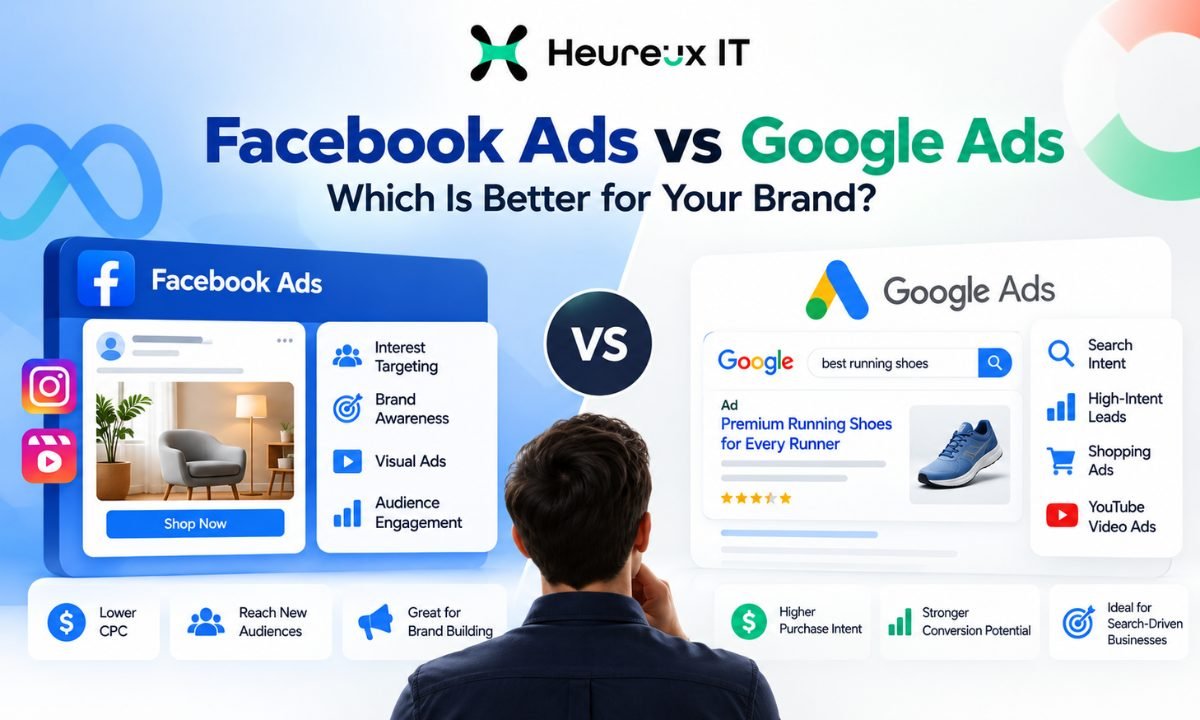
Google Search Ads connect businesses with people who are already searching for products or services. Facebook Ads help brands reach audiences based on interests, behavior, engagement, and other available targeting signals.
So, Facebook Ads vs Google Ads: which platform deserves more of your advertising budget?
The answer depends on your business goals, target audience, industry, and how customers make purchasing decisions.
At Heureux IT, we help businesses manage Google Ads and Meta Ads campaigns with a focus on lead generation, online sales, and measurable advertising performance.
This guide explains the key differences between these platforms, compares their costs, and helps you decide whether to choose one or use both.
What Is the Difference Between Facebook Ads and Google Ads?
The main difference is how each platform connects businesses with potential customers.
Google Search Ads primarily target people based on what they search for. Facebook Ads generally reach people while they browse social media, using audience signals and campaign optimization to identify potential customers.
For example, someone searching Google for "Emergency Plumber Near Me" is already looking for a service.
However, someone scrolling through Facebook might discover a home improvement company through an advertisement without searching for it.
Both methods can generate results, but they reach customers at different stages of the buying process.
Quick Comparison: Facebook Ads vs Google Ads
| Factor | Google Ads | Facebook Ads |
|---|---|---|
| Main Approach | Capture Existing Demand | Build Awareness and Generate Demand |
| Customer Intent | Often High for Search Ads | Often Discovery-Focused |
| Targeting | Keywords, Location, Audiences | Audience Signals, Interests, Engagement |
| Ad Formats | Search, Shopping, Display, Video | Images, Videos, Reels, Carousels |
| Typical Click Costs | Often Higher for Search | Often Lower for Social Traffic |
| Best Suited For | Search-Driven Services and Products | Visual Products and Brand Awareness |
| Lead Generation | Strong for Active Search Demand | Useful for Discovery and Lead Forms |
| Remarketing | Available Across Eligible Campaigns | Available Through Eligible Meta Audiences |
Neither platform guarantees better results. Campaign performance depends on the offer, competition, targeting, creative quality, landing pages, and tracking setup.
How Does Google Ads Work?
Google Ads is an online advertising platform that allows businesses to promote products and services across Google Search, YouTube, Maps, and other supported advertising placements.
Google Search campaigns can display advertisements when someone searches for relevant keywords.
For example, an accounting company may target searches such as:
- Accountant for Small Businesses
- Tax Preparation Services Near Me
- Business Accounting Consultant
- Bookkeeping Services in Chicago
These searches suggest that the user already has a problem or need.
Google Ads can help the business reach that person while they are looking for a solution.
Main Google Ads Campaign Types
Search Ads: Text-based advertisements that appear in relevant search results. Learn more about Google Search Ads.
Shopping Ads: Product advertisements that can include images, prices, and store information. Explore Google Shopping Ads Services.
Performance Max: Goal-based campaigns that use Google's automation across eligible advertising channels.
Display Ads: Visual advertisements shown across participating websites and applications.
Video Ads: Advertisements that help businesses reach audiences through YouTube and other supported placements.
Google Ads can support both lead generation and eCommerce businesses.
However, campaign success depends on selecting relevant keywords, setting suitable goals, managing budgets, and tracking conversions.
How Do Facebook Ads Work?
Facebook Ads are managed through Meta's advertising platform, which also supports advertising across Instagram and other eligible Meta placements.
Instead of relying on search keywords, Facebook advertising uses targeting settings and delivery systems to reach people who may be interested in a product or service.
For example, a clothing brand can show advertisements featuring its latest collection to potential shoppers.
A fitness company can promote a training program using video advertisements.
A local business can also run lead generation campaigns to collect inquiries from interested customers.
Main Facebook Advertising Formats
Image Ads: Promote products or services using a single image and advertising copy.
Video Ads: Demonstrate products, explain services, or share customer experiences.
Carousel Ads: Display multiple images or products within one advertisement.
Reels Ads: Reach audiences through short-form vertical video placements.
Lead Ads: Allow eligible users to submit their details through an instant form.
Remarketing Ads: Reconnect with eligible audiences who previously interacted with a business.
A professional Facebook Advertising Agency can help businesses choose suitable campaign goals, develop creative content, and improve advertising performance through testing.
Search Intent vs Interest Targeting: Which Is More Effective?
One of the most important differences between these platforms is the customer's intent.
Google Ads Focuses on Existing Search Demand
When someone searches for a specific product or service, they often have a clear reason for doing so.
For example, a person searching "Water Heater Repair Near Me" may need help with a broken water heater.
An advertisement that matches this search can connect the person with a relevant business.
This makes Google Search Ads useful for businesses offering services that customers actively look for.
Industries that often benefit include home services, professional services, healthcare, legal services, and B2B consulting.
Facebook Ads Helps Businesses Reach New Audiences
Facebook users are usually browsing content rather than searching for a specific service.
However, the right advertisement can introduce them to something relevant.
For example, someone might discover a new skincare product while watching Instagram Reels.
They may not purchase immediately, but the advertisement can encourage them to explore the product.
This makes Facebook advertising useful for businesses selling visually appealing products or introducing unfamiliar services.
Which Targeting Method Should You Choose?
If your customers are searching for a solution, Google Search Ads may be the better starting point.
If customers need to discover or understand your product before purchasing, Facebook Ads may offer greater value.
Some businesses benefit from combining both approaches.
Facebook Ads vs Google Ads: Cost Compared
Advertising cost is an important factor when deciding where to invest your marketing budget.
Both platforms use auction-based advertising systems, but actual costs vary by campaign type, competition, industry, location, and targeting.
Google Search Ads often have a higher Cost Per Click because advertisers compete for searches that may have strong purchase intent.
Facebook Ads often provide lower click costs for broader audience discovery, but cheaper clicks do not always produce cheaper customers.
Cost Per Click (CPC)
CPC represents the average amount paid for each advertisement click.
A business might receive inexpensive clicks from Facebook but generate few sales.
Meanwhile, a Google Search campaign could have higher click costs but attract visitors who are ready to purchase.
This is why CPC alone should not determine which platform is better.
Cost Per Lead (CPL)
Cost Per Lead measures how much a business spends to generate a lead.
For example, a campaign that spends $500 and generates 25 leads has a CPL of $20.
However, lead quality matters.
A campaign producing 10 qualified inquiries may be more valuable than one generating 40 inquiries from people who are not interested in buying.
Cost Per Acquisition (CPA)
Cost Per Acquisition measures advertising cost per defined conversion, such as a purchase or new customer.
The most useful measure depends on the business goal.
For lead generation, businesses should track not only form submissions but also qualified leads and customers gained.
For eCommerce, purchase costs and revenue are important.
Example: Why Cheaper Clicks Do Not Always Mean Better Results
The following example uses hypothetical campaign data to explain the difference.
| Metric | Google Search Ads | Facebook Ads |
|---|---|---|
| Advertising Spend | $1,000 | $1,000 |
| Average CPC | $4.00 | $1.00 |
| Clicks | 250 | 1,000 |
| Conversion Rate | 8% | 2% |
| Leads | 20 | 20 |
| Cost Per Lead | $50 | $50 |
Although Facebook generated four times as many clicks, both campaigns delivered the same number of leads.
This shows why businesses should evaluate conversions and customer quality instead of focusing only on traffic volume.
Which Platform Is Better for Lead Generation?
Both advertising platforms can generate leads, but their effectiveness depends on the type of business and customer intent.
Google Search Ads can be effective when customers already know what they need.
For example, someone searching for "Commercial Cleaning Services Near Me" may be ready to contact a cleaning company.
Facebook Ads can work well when businesses use a clear offer, such as a free consultation, product demonstration, or service quote.
Google Ads for Lead Generation
Google Ads can be a strong choice when:
- Customers actively search for your services.
- Your business offers solutions to urgent problems.
- You want to focus on high-intent keywords.
- Your website has a suitable landing page and contact form.
Facebook Ads for Lead Generation
Facebook Ads may be useful when:
- You want to introduce services to new audiences.
- Your offer benefits from images or videos.
- You want to collect inquiries using instant forms.
- You want to build awareness before customers are ready to buy.
Both platforms require accurate Conversion Tracking and a process for reviewing lead quality.
Which Platform Is Better for eCommerce Businesses?
eCommerce businesses can benefit from both platforms because customers discover and purchase products in different ways.
Google Ads for Online Stores
Google Shopping Ads can display products to people searching for specific items.
For example, someone searching for "Buy Running Shoes Online" may already have purchasing intent.
Google Shopping and Search campaigns can help businesses reach shoppers who are comparing products, prices, and brands.
These campaigns are useful when customers know what they want.
Facebook Ads for Online Stores
Facebook and Instagram allow brands to present products through images, videos, and lifestyle content.
For example, a fashion brand can show how its products look when worn.
A furniture company can demonstrate how a product fits into a home.
These advertisements can attract customers who were not planning to shop but become interested after seeing the product.
For many online stores, Google captures existing demand while Facebook and Instagram help create new interest.
Which Advertising Platform Works Best for Your Industry?
Choosing the right platform also depends on your business model.
| Business Type | Suggested Starting Platform | Reason |
|---|---|---|
| Plumbing and HVAC | Google Search Ads | Customers often search when they need service |
| Law Firms | Google Search Ads | High-intent service searches |
| Clothing Brands | Meta Ads | Strong visual product discovery |
| Beauty and Skincare | Meta Ads | Images and videos help explain products |
| B2B Consulting | Google Search Ads | Buyers may search for specific solutions |
| Restaurants | Both | Local searches and social promotion |
| Fitness Programs | Meta Ads | Video content and audience discovery |
| Online Electronics Stores | Google Shopping | Customers compare products and prices |
| Real Estate | Both | Search demand and visual property promotion |
These are starting recommendations, not fixed rules. Each business should review its audience, sales process, competition, and available budget before choosing a platform.
Want help turning this into results for your business?
Explore our Google Ads services →When Should You Run Both Facebook Ads and Google Ads?
Using both platforms can help businesses reach customers at different stages of their buying journey.
For example, a customer may first discover a product through an Instagram advertisement.
After seeing the product, they may visit the company's website without purchasing.
A few days later, they might search for the product on Google and click a Search advertisement.
In this situation, both platforms may have contributed to the purchase.
How a Combined Advertising Strategy Works
- Build Awareness: Introduce your product or service through Facebook and Instagram advertising.
- Generate Interest: Encourage potential customers to visit your website and explore your offer.
- Capture Search Demand: Use Google Search Ads to reach people who search for relevant products or services.
- Reconnect With Visitors: Use Meta Ads Retargeting to reach eligible audiences who previously interacted with your business.
- Measure Conversions: Track leads, purchases, and customer acquisition costs to evaluate campaign performance.
This approach can support awareness, consideration, and conversion.
Businesses can also use a Full-Funnel Advertising Strategy to organize campaigns around different stages of the buying process.
However, running both platforms does not automatically improve ROI. Each campaign should have a clear purpose and measurable results.
How Should You Split Your Advertising Budget?
There is no universal budget split that works for every business.
A local emergency service company may need to spend most of its budget on Google Search Ads.
A new fashion brand may prefer investing more in Facebook and Instagram advertising.
For businesses with enough budget to test both platforms, the following examples can serve as starting points.
| Business Goal | Google Ads | Meta Ads |
|---|---|---|
| High-Intent Lead Generation | 70% | 30% |
| Brand Awareness and Product Discovery | 30% | 70% |
| Balanced Lead Generation and Awareness | 50% | 50% |
| Search-Driven eCommerce Products | 60% | 40% |
These are illustrative allocations, not proven industry benchmarks.
The right split should depend on actual campaign performance, customer acquisition costs, and revenue.
If your total budget is small, focusing on one platform first may provide cleaner performance data than spreading spending across multiple campaigns.
How to Measure Facebook and Google Ads Performance
Both advertising platforms provide reporting tools, but businesses need to track meaningful results.
Important advertising metrics include:
- Conversions: Number of leads, purchases, or other valuable actions.
- CPL: Cost to generate a lead.
- CPA: Cost per defined conversion or acquisition.
- ROAS: Revenue attributed to advertising divided by advertising spend.
- Conversion Rate: Percentage of visitors completing a desired action.
- Customer Acquisition Cost: Total acquisition expense divided by new customers acquired.
Google Analytics 4, Google Tag Manager, Google Ads Conversion Tracking, and Meta Pixel can help businesses measure customer actions.
Meta Conversions API may also support appropriate server-side event measurement.
Because Google and Meta use different attribution methods, the same purchase may appear in reports from both platforms.
Businesses should avoid adding together platform-reported revenue without checking for overlapping conversions.
Using a proper GA4 Tracking Setup can help businesses understand website activity and measure advertising performance more accurately.
A reliable reporting process compares platform data with actual leads, orders, and customer records.
Common Mistakes Businesses Make With Paid Advertising
Businesses sometimes spend money on advertising without understanding why their campaigns are not performing well.
Common Google Ads Mistakes
Using irrelevant keywords, ignoring search terms, failing to add Negative Keywords, and sending visitors to unrelated landing pages can reduce campaign efficiency.
Poor Conversion Tracking can also make it difficult to identify which campaigns generate actual results.
You can learn more about common budget problems in our guide on Where Your Google Ads Budget Disappears.
Common Facebook Ads Mistakes
Using weak images or videos, choosing the wrong campaign objective, and failing to test advertisements can affect results.
Businesses may also focus on clicks instead of lead quality or purchases.
Another mistake is making frequent changes without enough data to understand campaign performance.
Both platforms require regular analysis, suitable creative content, and clear business goals.
How to Choose Between a Facebook Advertising Agency and a Google Ads Agency
If you need help managing paid advertising, choosing the right marketing partner is important.
A Google Ads Agency may be suitable for businesses that rely on Search Ads, Shopping campaigns, and high-intent lead generation.
A Facebook Advertising Agency may be more relevant for companies focused on social media advertising, product discovery, and Meta lead generation campaigns.
Before hiring an agency, ask about its experience with your industry, campaign tracking, reporting process, and approach to budget management.
A good agency should explain how it plans to improve advertising performance rather than promise guaranteed sales.
Our Verdict: Which Platform Should Your Brand Choose?
The best choice depends on what your customers do before purchasing.
Choose Google Search Ads first when customers already search for your product or service and your goal is to capture existing demand.
Choose Facebook Ads first when you need to build awareness, demonstrate products visually, or reach potential customers before they start searching.
Use both platforms when your budget supports testing and you want to reach customers throughout the buying journey.
For example, a local plumbing company may benefit more from Google Search Ads, while a new clothing brand may find stronger opportunities through Instagram and Facebook advertising.
However, both businesses could expand to the second platform once they understand their acquisition costs and conversion performance.
The most important factor is not which platform generates the cheapest clicks. It is which platform helps your business gain more valuable customers at a sustainable cost.
How Heureux IT Helps Businesses With Google Ads and Meta Ads
At Heureux IT, we help businesses develop advertising strategies based on their goals, budgets, and target audiences.
Our services include Google Ads Management, Meta Ads Management, Keyword Research, Audience Targeting, Ad Copy Optimization, Conversion Tracking, and Campaign Performance Analysis.
We focus on understanding what your business needs before recommending an advertising approach.
Whether you want to generate qualified leads, improve eCommerce sales, or reach new customers, choosing the right advertising platform is an important step.
Frequently Asked Questions
Is Facebook Advertising Better Than Google Ads? +
Neither platform is better for every business. Google Search Ads are often useful for reaching customers who are actively searching for products or services. Facebook Ads can help businesses introduce products, generate awareness, and reach potential customers through social media.
Which Is Cheaper, Facebook Ads or Google Ads? +
Facebook Ads often have lower click costs than Google Search Ads. However, lower CPC does not guarantee lower lead or customer acquisition costs. Businesses should compare conversion rates, lead quality, and revenue.
Which Platform Is Better for Small Businesses? +
The best choice depends on the business. Local service providers may benefit from Google Search Ads, while brands selling visual products may prefer Facebook and Instagram advertising. A small business should test the platform most closely connected to its customers' buying behavior.
Are Facebook Ads Good for Lead Generation? +
Yes. Facebook Ads for Businesses can support lead generation through instant forms, website campaigns, and audience targeting. Results depend on the offer, audience, creative content, and lead follow-up process.
Should I Run Facebook Ads and Google Ads Together? +
Running both can help businesses reach customers at different stages of the purchasing journey. Google Search Ads can capture existing demand, while Facebook Ads can generate awareness and support remarketing. The budget should be large enough to test and measure each campaign.
Which Platform Provides Better ROI? +
ROI depends on advertising costs, customer value, conversion rates, and campaign management. Google Search Ads may work well for high-intent services, while Facebook Ads may be effective for product discovery and visually driven businesses. Results should be measured using actual revenue and acquisition costs.
How Much Should a Small Business Spend on Advertising? +
There is no fixed minimum budget that guarantees results. Start with an amount that can produce useful performance data based on expected click costs and conversion rates. Businesses with limited budgets may benefit from testing one platform before expanding.
Can I Use Facebook Ads Without a Website? +
Some Meta lead generation campaigns allow businesses to collect inquiries through instant forms without sending visitors to a website. However, having a professional website can improve trust, provide more information, and support conversion tracking. Landing-page or website requirements may vary by campaign setup.
Conclusion
Choosing between Facebook and Google advertising depends on your business goals, target audience, and how customers discover your products or services.
Google Search Ads can help businesses connect with people who are already looking for a solution. Facebook and Instagram advertising can introduce your brand to new audiences and encourage interest through visual content.
Both platforms offer opportunities for lead generation, online sales, and business growth when campaigns are planned and measured.
At Heureux IT, we help businesses manage paid advertising with a focus on relevant traffic, qualified leads, and measurable results.
Ready to improve your advertising strategy? Contact Heureux IT to discuss your business goals and find the right platform for your marketing budget.
Heureux IT is a digital marketing agency specialising in Google Ads, Meta Ads and SEO. We help growing businesses turn paid and organic search into measurable revenue.