Imagine searching for your business services on ChatGPT or Perplexity and finding that the AI recommends three competitors but never mentions your website.
Your website may already rank on Google. You might have useful blog posts, optimized service pages, and a strong backlink profile. Yet your content doesn't appear in the AI-generated answer.
Why does this happen?
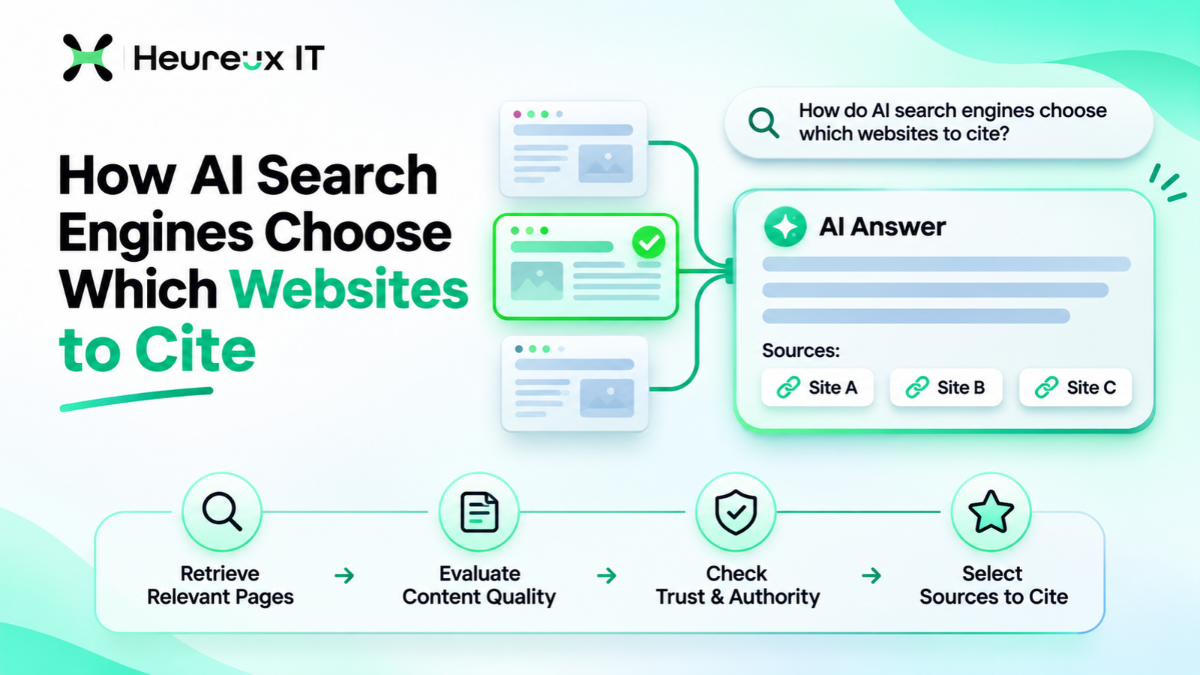
The answer lies in how AI search engines retrieve information, evaluate sources, and select websites to support their responses.
Unlike traditional search engines, AI-powered search experiences can gather information from multiple sources and combine it into a direct answer. This makes having a strong SEO Strategy important for businesses that want to improve their visibility across traditional and AI-powered search.
AI Search Citations are references to websites or other sources that support information presented in an AI-generated response. To improve your chances of receiving these citations, your website needs relevant content, accessible pages, clear explanations, and trustworthy information.
However, a high Google ranking does not guarantee that an AI platform will cite your website.
This guide explains how AI search engines choose websites to cite, which factors may influence source selection, and what businesses can do to improve their visibility across ChatGPT Search, Google AI Overviews, Gemini, and Perplexity.
What Are AI Search Citations?
AI Search Citations are links or references that identify sources used to support information in an AI-generated answer.
When someone asks an AI search engine a question, the platform may retrieve information from websites, documents, and other available sources.
It can then use that information to generate a response and provide links that help users verify the answer.
For example, imagine someone searching for:
“How can a small business reduce its Google Ads cost per lead?”
An AI search engine might retrieve information about keyword targeting, negative keywords, landing page optimization, bidding strategies, and conversion tracking.
Instead of displaying only a list of search results, it may summarize the recommendations and cite relevant websites.
For businesses, these references create another opportunity to reach people who are researching products or services.
However, not every AI-generated response involves live web searches. Some responses rely on the model's existing knowledge or other available information.
Even when an AI system retrieves a website, it may not include that website in the final citations.
AI Citations vs. Traditional Search Results
| Factor | Traditional Search Results | AI Search Citations |
|---|---|---|
| Main purpose | Help users find relevant web pages | Support information in generated answers |
| Presentation | Ranked links and search features | Links or references within AI responses |
| Content selection | Search ranking and retrieval systems | Retrieval, answer generation, and source attribution |
| User experience | Users choose which results to open | Users may read a summary before visiting a source |
| Visibility measurement | Rankings, impressions, and clicks | Citations, mentions, and referral traffic |
| Guaranteed traffic | No | No |
Both approaches can help businesses become visible online.
The difference is how users discover and interact with information.
How Do AI Search Engines Choose Websites to Cite?
AI search engines do not all use the same source-selection process.
Their retrieval systems, search indexes, and citation methods can differ.
However, a useful way to understand AI source selection is through five stages.
Step 1: Understanding the User's Question
The process begins when someone submits a question.
The AI system identifies the subject, the user's likely intent, and the information needed to provide a useful response.
For example:
“Which advertising platform is better for a local dental clinic, Google Ads or Facebook Ads?”
This question involves several considerations.
The AI may need information about advertising costs, patient intent, audience targeting, lead quality, and campaign objectives.
A useful answer should explain the differences rather than recommend one platform without context.
Websites that address these specific questions may become relevant sources.
Step 2: Finding Relevant Information Through Search
When the AI system uses web retrieval, it searches for content related to the question.
Depending on the platform, this may involve its own search index, external search services, or other retrieval tools.
Some AI search experiences also use query fan-out.
Query fan-out involves breaking a complex question into smaller, related searches.
For example:
| Original Question | Possible Search Query |
|---|---|
| Google Ads vs. Facebook Ads for dentists | Google Ads for dental clinics |
| Google Ads vs. Facebook Ads for dentists | Facebook Ads dental lead generation |
| Google Ads vs. Facebook Ads for dentists | Dental advertising cost per lead |
| Google Ads vs. Facebook Ads for dentists | Search intent vs. social media targeting |
The system can retrieve information covering different parts of the original question.
This matters because your website does not necessarily need to cover every aspect of a broad topic on one page.
A focused article explaining one important part of the question may also be useful.
Step 3: Identifying Relevant Content Passages
After retrieving pages, the system may identify specific passages that help answer the question.
These could include definitions, comparisons, examples, technical explanations, or product details.
Consider two articles about Meta Ads.
The first article discusses the general benefits of Facebook advertising.
The second explains why Meta Ads generate low-quality leads and describes how to improve lead forms, targeting, and CRM tracking.
If someone asks why their Facebook leads are not converting into customers, the second article provides more relevant information.
This is why direct answers and clear content structure matter.
Step 4: Evaluating the Information
The system may consider whether retrieved information is useful for the response.
Relevant considerations can include factual accuracy, consistency with other information, source credibility, and how closely a passage matches the question.
However, AI platforms have not published one universal set of citation ranking factors.
It would be misleading to claim that every AI search engine assigns the same weight to backlinks, freshness, content structure, or domain authority.
Businesses should therefore focus on producing accurate, useful content rather than trying to satisfy an assumed citation score.
Step 5: Generating the Answer and Selecting Citations
The final stage involves generating a response using the information available to the system.
The AI may reference several websites, cite one source for a specific statement, or display a collection of supporting links.
Not every retrieved page receives a citation.
A page may help the system understand the topic without appearing as a visible source.
Similarly, an AI-generated answer may mention a brand without linking to its website.
The important distinction is that retrieval, citation, and brand mentions are different outcomes.
What Factors Can Influence AI Search Citations?
Several content and technical factors can affect whether a website becomes a useful source for AI search.
1. Content Relevance and Search Intent
A page should answer the question the user is asking.
For example, someone searching for “why is my website not appearing in Google” needs troubleshooting guidance.
An article explaining the history of search engines would not meet that intent.
Relevant content should explain the problem, identify possible causes, and offer practical solutions.
Businesses can improve content relevance by reviewing customer questions, search queries, and common support requests.
2. Clear Content Structure
A well-organized article makes information easier to find and understand.
Use descriptive headings, logical sections, and direct explanations.
For example, a section titled “How Does Meta Pixel Track Purchases?” is more descriptive than “Understanding the Process.”
The first heading identifies the subject and the question being answered.
Short paragraphs can also help readers follow complex explanations.
However, content structure alone does not guarantee that an AI search engine will cite a page.
3. Accurate and Trustworthy Information
Accuracy matters when publishing content that readers may use to make decisions.
If your website discusses advertising performance, explain the measurement method behind important claims.
For example, instead of writing:
“Our advertising strategy improves conversions by 200%.”
Explain the campaign type, reporting period, conversion definition, and supporting data if those results are genuine.
Original evidence gives readers a reason to trust the information.
It can also make the page more useful as a source.
4. Experience, Expertise, Authoritativeness, and Trust
Google uses the concept of E-E-A-T to describe qualities associated with helpful, reliable content.
These qualities include experience, expertise, authoritativeness, and trustworthiness.
E-E-A-T is not a single numerical ranking score, and it should not be treated as a universal AI citation formula.
Still, businesses can demonstrate credibility through accurate author information, genuine case studies, transparent business details, and relevant experience.
For a digital marketing agency, detailed campaign troubleshooting guides can demonstrate practical knowledge better than broad promotional claims.
5. Content Freshness
Some information becomes outdated quickly.
Advertising platform features, software pricing, product specifications, and industry regulations may change.
A guide about Meta Ads targeting written several years ago could contain instructions that no longer match the current interface.
Review such articles when meaningful changes occur.
For evergreen topics, accuracy is more important than changing the publication date.
6. Website Crawlability and Accessibility
AI search systems need access to relevant information before they can use it through retrieval.
A website may have excellent content but remain difficult to access because of technical restrictions.
Common issues include blocked crawlers, incorrect robots.txt rules, inaccessible pages, server errors, and content hidden behind login requirements.
Technical SEO helps identify these problems.
Businesses should also check whether important content is available in rendered HTML and whether relevant search systems can retrieve it.
7. Brand Reputation and Independent Mentions
Information about your business may appear outside your own website.
Examples include relevant industry publications, customer reviews, directories, and independent articles.
These references can help people discover and evaluate your brand.
They may also provide additional information to search systems.
However, there is no reliable universal rule stating that a certain number of mentions will produce AI citations.
Prioritize genuine, relevant mentions rather than low-quality link building.
Does Ranking First on Google Guarantee AI Search Citations?
No. Ranking first on Google does not guarantee that an AI search engine will cite your website.
Traditional search rankings and AI-generated answers use different presentation and selection processes.
A website may rank well for a broad keyword but fail to provide the most useful information for a specific question.
For example, a general article about Google Ads might rank for a competitive keyword.
But an article explaining how to fix duplicate purchase conversions may be more relevant when someone asks about that exact problem.
The focused article could become a useful source even if it receives less overall organic traffic.
This does not mean businesses should abandon traditional SEO.
Strong technical accessibility, relevant content, and clear website structure remain important.
The goal is to build a website that works for both search engines and the people using them.
Want help turning this into results for your business?
Explore our SEO services →How Do Different AI Search Platforms Use Website Sources?
ChatGPT Search, Google AI Overviews, Gemini, and Perplexity can all provide information supported by external sources.
However, their tools and citation experiences differ.
| Platform | General Approach | Important Consideration |
|---|---|---|
| ChatGPT Search | Can retrieve web information and display source links | Citation results depend on the question and retrieved information |
| Google AI Overviews | Generates summaries within Google Search | Google Search accessibility and relevant content remain important |
| Google AI Mode | Can explore related questions using query fan-out | Detailed coverage of relevant subtopics can be useful |
| Gemini | Can use Google Search grounding and other available tools | Source availability depends on the product and context |
| Perplexity | Uses web retrieval and displays supporting sources | Clear, relevant information can help answer specific questions |
A website appearing in one platform does not guarantee visibility in another.
Even the same platform may produce different sources for similar questions.
Businesses should monitor multiple platforms rather than relying on one test.
How to Optimize Your Website for AI Search Citations
Improving AI search visibility requires a combination of content planning, technical SEO, and regular monitoring.
The following steps provide a practical starting point.
Step 1: Identify Questions Your Customers Ask
Start with questions related to your products or services.
A digital marketing agency might receive questions such as:
- Why are my Google Ads getting clicks but no leads?
- How can I improve Meta Ads lead quality?
- Why do GA4 and Google Ads show different conversions?
- How much should I spend on paid advertising?
- Why is my website losing organic traffic?
These questions can become blog topics, service page sections, or supporting guides.
Choose topics where your business can provide useful answers based on genuine experience.
Step 2: Answer Important Questions Directly
Avoid introductions that delay the answer.
For example, if the heading asks “What Is Conversion Tracking?”, begin with a clear definition.
Then explain how conversion tracking works, why it matters, and which problems businesses commonly encounter.
This approach makes the article useful for readers who want a quick answer and those who need more detail.
Step 3: Create Detailed Topic Coverage
A strong article should address the main subject and its relevant supporting questions.
For example, a guide about Google Ads lead quality might cover keyword targeting, search terms, landing pages, conversion actions, and offline lead tracking.
Each section should contribute useful information.
Avoid adding unrelated content simply to increase the word count.
Step 4: Improve Internal Linking
Internal links help visitors navigate between related pages.
They also help search engines discover content and understand website relationships.
For example, a blog about Google Ads performance can link naturally to Heureux IT's Google Ads services.
An article about Performance Max can link to the relevant Performance Max service page.
Use descriptive anchor text that explains the destination.
Avoid placing links where they interrupt the reading experience.
Step 5: Use Appropriate Structured Data
Structured data helps search engines understand certain information about a page.
A blog article may use BlogPosting schema to identify its headline, publisher, and other details.
Organization and BreadcrumbList schema can provide additional context.
However, structured data does not guarantee AI citations.
It should describe information that is accurate and consistent with the visible page.
Step 6: Review Technical SEO
Check whether important pages are accessible and suitable for indexing.
Review robots.txt, canonical tags, XML sitemaps, internal links, and server responses.
Also inspect mobile usability and important content rendered through JavaScript.
If a search system cannot retrieve the relevant content, your opportunities for citation through that system may be limited.
Step 7: Add Original Examples and Insights
Original information can make content more valuable.
For example, an agency could explain how it diagnoses a campaign with high click volume but low lead quality.
The article might cover search term analysis, conversion action reviews, landing page checks, and CRM feedback.
Real examples can help readers understand how recommendations work in practice.
Do not invent campaign results or claim experience that cannot be supported.
Step 8: Monitor AI Search Visibility
Test questions that matter to your business.
Record which platforms mention your brand, which pages receive citations, and which competitors appear.
Review the results over time.
AI-generated responses can change, so avoid drawing conclusions from a single search.
AI Search Optimization Checklist
Use this checklist when reviewing an important blog or service page.
| Optimization Area | What to Check | Why It Matters |
|---|---|---|
| Search Intent | Does the page answer a specific customer question? | Improves relevance |
| Content Quality | Are explanations accurate and useful? | Supports reader trust |
| Heading Structure | Are H1, H2, and H3 headings clear? | Improves content organization |
| Original Information | Does the page provide examples or useful insights? | Adds value beyond generic advice |
| Internal Links | Are related pages connected naturally? | Supports navigation and discovery |
| Crawlability | Can relevant search systems access the page? | Supports retrieval |
| Canonical Tags | Is the preferred URL identified correctly? | Reduces conflicting URL signals |
| Structured Data | Does schema match the visible content? | Provides machine-readable context |
| Content Updates | Are time-sensitive facts current? | Helps maintain accuracy |
| AI Visibility | Are citations and mentions monitored? | Supports ongoing evaluation |
This checklist cannot guarantee citations.
It can help identify content and technical improvements that benefit both traditional SEO and AI-driven discovery.
How Can Businesses Measure AI Search Citations?
Measuring AI search visibility requires more than checking whether a website appears in one generated answer.
Businesses should track several types of information.
Track Website Citations
Create a list of relevant customer questions.
Search those questions across the AI platforms you want to monitor.
Record the date, platform, cited website, and specific URL.
This provides a basic record of citation visibility.
Track Brand Mentions
An AI platform may mention a company without providing a direct website citation.
Record these mentions separately.
A citation identifies a source, while a brand mention can introduce the business within the answer.
Both can matter, but they should not be counted as the same metric.
Review AI Referral Traffic
Use analytics to identify visits from AI platforms when referral information is available.
Review engagement, form submissions, purchases, and other valuable actions.
Remember that not all visits influenced by AI-generated answers will appear under a clear AI referral source.
Compare Competitor Visibility
Check which competitors appear for the same questions.
Review the topics they cover and the information their pages provide.
This may reveal useful content gaps.
However, avoid assuming that copying a competitor's page structure will produce the same citations.
Monitor Search Performance
Google Search Console can help identify search visibility, indexing, and page performance issues.
Bing Webmaster Tools also provides AI Performance information for supported Microsoft AI experiences.
Use these tools alongside manual citation checks and analytics.
Common AI Search Optimization Mistakes to Avoid
Several common mistakes can reduce the usefulness of a website's content.
Publishing Content Only for Keywords
Keyword research is useful, but repeating the same phrase throughout an article does not guarantee visibility.
Focus on the reader's question.
Use keywords naturally and provide a complete answer.
Writing Generic AI-Generated Articles
Content that repeats common advice without examples or meaningful details may offer little value.
Review every article for accuracy.
Add practical explanations, genuine experience, and information that helps readers make decisions.
Ignoring Technical Website Problems
Publishing more content will not resolve blocked pages, broken links, or serious accessibility issues.
Review technical SEO before expanding content production.
Using Unsupported Statistics
Avoid presenting estimates or marketing claims as proven facts.
If you discuss campaign results, explain the source and reporting method.
Accuracy is more valuable than an impressive number without evidence.
Heureux IT is a digital marketing agency specialising in Google Ads, Meta Ads and SEO. We help growing businesses turn paid and organic search into measurable revenue.