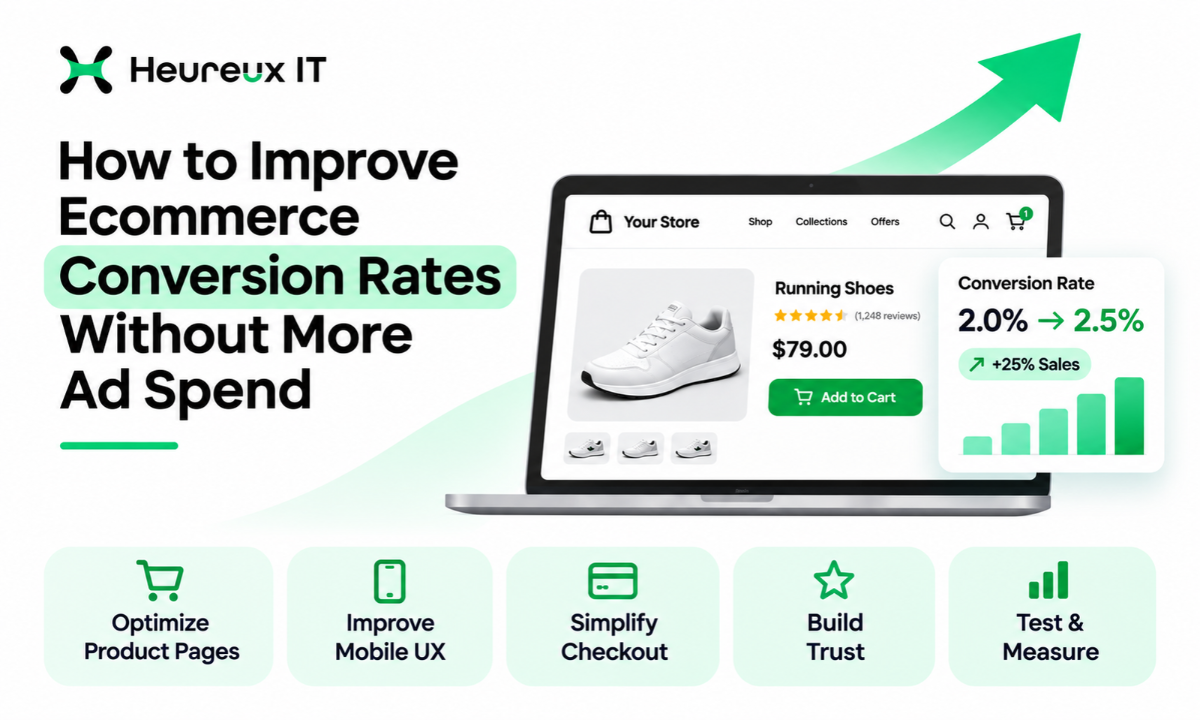
Getting more visitors to your Ecommerce website doesn't always mean getting more sales.
You might be spending hundreds or thousands of dollars on Google Ads and Meta Ads, attracting visitors to your product pages, and watching customers add items to their carts.
But when you review your orders, the numbers don't match your expectations.
Your first thought might be to increase the advertising budget.
More traffic should bring more customers, right?
Not necessarily.
If shoppers struggle to understand your products, navigate your website, or complete checkout, increasing advertising spend may simply bring more visitors into the same frustrating experience.
That's where Ecommerce Conversion Rate Optimization becomes important.
Instead of spending more to attract additional visitors, conversion optimization focuses on helping your existing visitors complete purchases.
Better product descriptions, faster mobile pages, clearer offers, genuine customer reviews, and simpler checkout processes can all help remove barriers to purchasing.
For businesses using Shopify, WooCommerce, or other Ecommerce platforms, these improvements can create more sales opportunities without requiring additional advertising spend.
In this guide, we'll explain how Ecommerce Conversion Rate Optimization works, why customers abandon online stores, and the practical improvements businesses can make to increase sales from their existing traffic.
What Is Ecommerce Conversion Rate Optimization?
Ecommerce Conversion Rate Optimization (CRO) is the process of improving an online shopping experience to increase the percentage of visitors who complete purchases.
It involves identifying where shoppers encounter problems and making improvements based on customer behavior and website data.
For example, an online clothing store may attract thousands of visitors but receive relatively few orders.
An analysis might reveal that customers frequently leave product pages because size information is missing.
Adding a useful size guide could help customers make purchasing decisions with more confidence.
Similarly, an Ecommerce business might discover that customers abandon checkout after unexpected delivery charges appear.
Displaying shipping information earlier could reduce that friction.
The purpose of Ecommerce CRO is not to pressure visitors into buying. It's to make purchasing easier for customers who are already interested.
How to Calculate Ecommerce Conversion Rate
A common session-based calculation is:

Some Ecommerce reports instead divide orders by sessions, so check which definition your analytics platform uses.
For example, suppose your online store receives 10,000 sessions and records 200 sessions with purchases.
Your conversion rate would be 2%.
Now imagine the number of visitors stays the same, but you improve the conversion rate to 2.5%.
Example: More Purchases Without More Traffic
Before Optimization: 200
Purchasing sessions at 2% conversion
After Optimization: 250
Purchasing sessions at 2.5% conversion
Purchasing sessions with 10,000 website sessions
Illustrative comparison using the same traffic volume.
That is a 25% increase in purchasing sessions from the same traffic. Results are illustrative, not guaranteed.
This is why improving conversion rates can be valuable for online retailers.
Why Ecommerce Conversion Rate Optimization Matters
Many Ecommerce businesses focus heavily on attracting new customers.
They invest in search advertising, social campaigns, influencers, and organic traffic.
These channels can bring valuable visitors, but their effectiveness depends partly on what happens after someone arrives.
Make Better Use of Existing Traffic
If your store already receives relevant visitors, fixing conversion problems may help produce more purchases from those sessions.
Improve Advertising Efficiency
Better conversion performance can reduce the effective cost of acquiring customers when advertising costs remain stable.
For example, if the same advertising budget produces more purchases, cost per acquisition can improve.
Improve Customer Experience
Customers benefit from accurate product information, clear pricing, and a simple buying process.
Support Profitability
Higher conversion rates can support revenue growth without proportional increases in acquisition spending.
However, profitability still depends on margins, discounts, fulfillment costs, and other expenses.
What Is a Good Ecommerce Conversion Rate?
There is no single conversion rate that every Ecommerce business should target.
Results depend on product category, price, customer intent, traffic source, geography, and device.
A store selling inexpensive everyday products may convert differently from a company selling premium furniture.
Similarly, returning customers may behave differently from first-time visitors.
Instead of focusing entirely on industry averages, establish a baseline using your own historical performance.
Compare purchase conversion rates by traffic channel, device, product category, and customer segment.
The aim is to improve the metrics that matter to your business.
Why Your Ecommerce Website Gets Traffic but Few Sales
Before changing your website, understand where customers leave the buying journey.
A problem on the homepage is different from a problem during checkout.
| Customer Journey Stage | Possible Conversion Problem |
|---|---|
| Landing Page | Advertising message doesn't match the page |
| Product Discovery | Confusing categories or search filters |
| Product Page | Incomplete product details or unclear benefits |
| Shopping Cart | Unexpected costs or confusing offers |
| Checkout | Too many fields, payment failures, or limited payment options |
| Post-Purchase | Poor customer experience affects future orders |
For example, if customers visit product pages but rarely add products to their carts, investigate price, content, product suitability, and customer trust.
If customers add products but abandon checkout, investigate shipping costs, payment options, and technical problems.
Understanding the point of friction helps you choose the right improvement.
12 Ecommerce Conversion Rate Optimization Strategies That Can Increase Sales
The following strategies focus on improving existing shopping traffic rather than increasing advertising budgets.
1. Attract the Right Customers With Your Existing Ad Spend
One of the most overlooked parts of Ecommerce Conversion Rate Optimization is traffic quality.
Not every visitor who clicks an advertisement intends to purchase.
A campaign may generate inexpensive clicks but attract customers who are looking for information rather than products.
Review Your Advertising Sources
Analyze traffic from Google Ads, Meta Ads, organic search, and email campaigns.
Compare purchase conversion rates, revenue, and customer acquisition costs.
Identify which campaigns attract customers who complete purchases.
Improve Campaign Relevance
Make sure advertisements match your products and target audience.
For example, if you sell premium running shoes, advertisements should communicate their actual features and price positioning rather than attracting customers looking for cheap footwear.
Businesses using Google Shopping Ads Management can improve product advertising relevance through accurate product information and suitable campaign structures.
The goal is to make existing advertising traffic more valuable.
2. Optimize Your Ecommerce Product Pages
Product pages are often where customers decide whether to buy.
A strong product page should answer important questions without forcing visitors to search for information elsewhere.
Include Clear Product Information
Display the product name, price, important features, specifications, and available options.
For clothing, customers may need material details and sizing information.
For electronics, compatibility, dimensions, and technical specifications may matter more.
Explain Product Benefits
Customers want to understand how a product helps them.
Instead of listing features alone, explain their practical use.
For example, a water bottle description could explain its capacity, materials, and suitable use rather than relying on generic claims.
Make Buying Actions Easy
Ensure that the Add to Cart button is visible and works correctly.
Clearly display available sizes, colors, and other product variations.
Avoid placing important information behind confusing menus.
Well-organized product pages can help customers make informed buying decisions.
3. Improve Your Mobile Shopping Experience
A large share of Ecommerce discovery happens on mobile devices.
Customers may first encounter products through Instagram, Facebook, Google Shopping, or mobile search.
If the website is difficult to use on a phone, those visitors may leave.
Test the Entire Buying Process
Open your store on a real smartphone.
Browse a collection, open a product, select a variation, add it to the cart, and complete a test checkout.
Ask whether each step is clear and easy to complete.
Improve Mobile Navigation
Use readable fonts, touch-friendly buttons, and simple menus.
Avoid intrusive pop-ups that cover product information or purchasing controls.
Reduce Loading Problems
Optimize product images, review unnecessary scripts, and use appropriate website caching.
Technical improvements to a Shopify Ecommerce Website can help address usability and performance issues.
The focus should be on making shopping easier, not simply making the site look attractive.
4. Simplify Your Ecommerce Website Navigation
Customers shouldn't have to search through several unrelated categories to find products.
Clear navigation helps visitors reach the items they want.
Organize Product Categories
Group products according to how customers shop.
For example, a footwear store might organize collections by running, walking, casual wear, and sports.
Add Relevant Product Filters
Useful filters may include size, price, color, brand, and product type.
Avoid overwhelming shoppers with unnecessary options.
Improve Website Search
Customers who know what they want often use the search bar.
Make sure product searches return relevant results.
Helpful navigation reduces effort and keeps the buying journey focused.
5. Use Better Product Images and Videos
Online customers cannot physically inspect products before purchasing.
Images and videos help them understand appearance, features, and use.
Show Products From Multiple Angles
Provide clear photographs that accurately represent the product.
Include close-ups when important details might influence the purchase.
Add Relevant Demonstrations
A short video may help shoppers understand how a product works.
For example, an outdoor equipment store could demonstrate product setup and important features.
Use Genuine Customer Content
When customers provide permission, real photographs or videos can help others understand product experiences.
Avoid misleading images or exaggerated demonstrations.
Better product content reduces uncertainty during the purchase decision.
6. Build Customer Trust With Reviews and Clear Policies
A visitor may find your product attractive but hesitate because they don't know whether to trust the store.
Trust is especially important for newer Ecommerce brands.
Display Genuine Product Reviews
Customer reviews can provide useful information about product quality, sizing, delivery, and service.
Include authentic feedback and respond appropriately to customer concerns.
Make Business Details Easy to Find
Clearly display contact information, return policies, shipping details, and customer support options.
Customers should know what happens if their order arrives late or doesn't meet expectations.
Avoid Misleading Trust Signals
Don't use fabricated testimonials, false stock shortages, or unsupported guarantees.
Trust comes from accurate information and a reliable customer experience.
Want help turning this into results for your business?
Explore our Google Ads services →7. Improve Your Ecommerce Offers Without Heavy Discounts
Not every conversion problem requires lower prices.
Sometimes customers need a clearer explanation of the value they receive.
Review Your Pricing Presentation
Display prices clearly.
Explain shipping charges and any conditions attached to promotional offers.
Consider Product Bundles
Bundles can help customers purchase related items together.
For example, a skincare retailer might offer a cleanser, moisturizer, and sunscreen bundle.
The bundle should provide genuine value rather than disguise higher costs.
Offer Clear Shipping Thresholds
A free-shipping threshold may encourage customers to add relevant products to their orders.
However, evaluate shipping expenses and product margins before introducing one.
Strong offers should support both customer value and business profitability.
8. Reduce Cart Abandonment and Checkout Friction
A customer can be interested in buying and still leave during checkout.
Unexpected costs, complicated forms, payment problems, and required account creation are common sources of friction.
Simplify Checkout Forms
Ask customers for the information needed to complete their orders.
Enable guest checkout where suitable.
Use address autofill and appropriate form validation.
Show Costs Before the Final Step
Make product prices, delivery fees, and other applicable charges clear.
Customers shouldn't discover major costs only after completing several checkout steps.
Provide Relevant Payment Methods
Offer payment choices suited to your target market.
These may include cards, digital wallets, or other supported local methods.
Test Checkout Regularly
Complete test purchases on different devices.
Check whether payment errors, broken buttons, or confusing messages affect the experience.
A smoother checkout process can help customers complete purchases they already intend to make.
9. Match Your Advertisements With Your Landing Pages
Imagine seeing an Instagram advertisement for a particular jacket at a promotional price.
You click the advertisement, but the website opens a homepage showing unrelated products.
Now you need to find the jacket and confirm whether the offer applies.
This creates unnecessary friction.
Use Relevant Landing Pages
Direct product advertisements to corresponding product pages.
For collection promotions, send customers to relevant collection pages.
Maintain Message Consistency
The product, price, and offer shown in the advertisement should match the landing page.
Keep Calls to Action Clear
Customers should understand whether they can purchase immediately, select a variation, or explore related products.
Professional Landing Page Services can support a clearer customer journey from advertising to checkout.
10. Recover Abandoned Carts Without Increasing Advertising Spend
Some shoppers leave because they are comparing products, become distracted, or need more time.
Appropriate cart recovery can encourage interested customers to return.
Send Helpful Cart Reminders
Where customers have provided the necessary consent, use email or other permitted communication methods to remind them about their carts.
Make it easy to resume shopping.
Address Common Concerns
If customers abandon purchases due to delivery uncertainty, provide clear shipping information.
If payment methods are limited, consider offering suitable alternatives.
Avoid Excessive Discounting
Repeated discounts may reduce margins and train customers to wait for promotions.
Fix the underlying buying friction before relying on incentives.
11. Track Ecommerce Conversions With Google Analytics 4
Reliable data is essential for Ecommerce Conversion Rate Optimization.
Without accurate tracking, businesses may struggle to understand why customers leave their websites.
Google Analytics 4 supports Ecommerce events that describe shopping activity.
Important GA4 Ecommerce Events
| Event | What It Tracks |
|---|---|
| view_item | Customer views a product |
| add_to_cart | Customer adds a product to the cart |
| begin_checkout | Customer begins checkout |
| add_payment_info | Customer submits payment information |
| purchase | A completed purchase is recorded |
| refund | A refund is recorded |
These events help you understand the buying journey.
For example, a high number of product views but few add-to-cart actions may suggest that product information, pricing, or relevance needs investigation.
If customers begin checkout but don't complete purchases, examine the checkout experience.
Events identify patterns, but additional investigation is needed to confirm the cause.
Heureux IT's GA4 Tracking Services can support accurate measurement of important Ecommerce interactions.
12. Use A/B Testing to Improve Conversion Rates
A/B testing compares different versions of a page or element to determine which performs better.
For example, an online store might test two product-page layouts.
One layout displays delivery information near the Add to Cart button.
Another places the information below the product description.
The store can evaluate whether the change influences completed purchases.
What Can You Test?
Useful tests include product images, headlines, calls to action, product descriptions, shipping messages, and page layouts.
Start With High-Traffic Pages
Pages with meaningful visitor volume generally provide more useful testing opportunities.
Measure the Right Outcome
Increasing button clicks isn't necessarily an improvement if purchases stay unchanged.
Choose a primary metric that reflects the business goal.
Avoid Making Decisions Too Early
Small samples can produce misleading results.
Use appropriate sample sizes and testing periods before drawing conclusions.
A structured CRO & A/B Testing Strategy can help businesses assess improvements using performance data.
Ecommerce Conversion Rate vs Average Order Value
Conversion rate tells you how often website sessions produce purchases.
Average order value, or AOV, tells you how much customers spend per order.
Both matter.
Average Order Value Formula
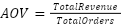
For example, a store generating $12,000 from 200 orders has an AOV of $60.
If the same number of orders produces an AOV of $70, revenue increases to $14,000.
However, higher revenue doesn't always mean higher profit.
Evaluate discounts, product costs, shipping, and fulfillment expenses when reviewing AOV improvements.
How to Identify Where Your Ecommerce Store Is Losing Sales
Before redesigning your website, use customer behavior data to identify where friction occurs.
| Problem | Area to Investigate |
|---|---|
| High Traffic, Few Product Views | Landing Pages and Navigation |
| Product Views, Few Cart Additions | Product Content, Pricing, Customer Trust |
| Cart Additions, Few Checkout Starts | Shopping Cart and Shipping Information |
| Checkout Starts, Few Purchases | Payment Methods, Forms, Technical Errors |
| Lower Mobile Conversion | Mobile Usability and Checkout |
| Strong Conversion, Low Revenue | Average Order Value and Product Mix |
For example, if most visitors leave before viewing a product, improving checkout may not be your first priority.
Instead, investigate navigation and the relevance of landing pages.
If customers regularly reach checkout but don't complete purchases, product discovery may already be working.
Focus on the final buying steps.
Ecommerce Conversion Rate Optimization Checklist
Use this checklist before increasing your advertising budget.
Store Optimization Checklist
0 of 12 complete
- Review traffic quality and purchasing behavior
- Improve high-traffic product pages
- Check mobile usability and website speed
- Make navigation and product search easier
- Use accurate product images and descriptions
- Display genuine customer reviews
- Clarify pricing, shipping, and return policies
- Remove unnecessary checkout steps
- Offer suitable payment methods
- Review abandoned-cart recovery
- Check GA4 Ecommerce event tracking
- Test improvements and monitor purchases
- Reset Copy Checklist
When Should You Hire an Ecommerce CRO Specialist?
Some conversion problems are straightforward.
For example, adding a missing size guide or clarifying a delivery policy may be a small change.
Other issues require a deeper analysis of website data, customer behavior, and technical performance.
An Ecommerce CRO specialist may be useful when your store receives consistent traffic but struggles to turn visits into purchases.
Professional support can include analytics reviews, product-page improvements, checkout testing, and conversion tracking.
The objective should be to identify measurable improvements rather than promise a fixed increase in conversion rate.
How Heureux IT Approaches Ecommerce Conversion Rate Optimization
At Heureux IT, we understand that successful Ecommerce marketing involves more than generating website traffic.
Every stage of the shopping journey can influence whether a visitor becomes a customer.
Our approach considers product-page usability, landing-page relevance, checkout experience, conversion measurement, and structured testing.
For businesses running paid advertising, this may involve improving the connection between campaign messaging and landing pages.
For established Ecommerce stores, the priority may be identifying checkout friction or improving high-traffic product pages.
For growing businesses, the focus may involve building reliable analytics and testing processes.
The goal is to help businesses make better use of their website traffic while supporting sustainable revenue growth.
Final Thoughts
Ecommerce Conversion Rate Optimization helps businesses focus on the customers they already attract.
Increasing advertising spending isn't always necessary to create more sales opportunities.
Sometimes, the most important improvements involve making your website easier to use.
Clear product information, accurate photographs, transparent shipping costs, genuine reviews, mobile-friendly layouts, and simple checkout processes can help customers complete purchases with greater confidence.
Combine these improvements with reliable analytics and ongoing testing.
Measure purchases, revenue, average order value, and profitability rather than focusing on conversion rate alone.
At Heureux IT, we help Ecommerce businesses improve website experiences, conversion tracking, and customer journeys.
Explore our Ecommerce CRO Services or Contact Heureux IT to discuss how your online store can generate more value from existing traffic.
Frequently Asked Questions
What Is Ecommerce Conversion Rate Optimization? +
Ecommerce Conversion Rate Optimization is the process of improving an online store to increase the percentage of visitors who complete purchases or other valuable actions.
How Can I Improve Ecommerce Conversion Rates Without More Ad Spend? +
Improve product descriptions, navigation, mobile usability, checkout, customer reviews, and landing-page relevance. Use analytics to identify where customers abandon the buying process.
What Is a Good Ecommerce Conversion Rate? +
There is no single ideal rate. Conversion performance varies by industry, product price, traffic source, device, and customer behavior.
Why Does My Ecommerce Website Get Traffic but No Sales? +
Possible reasons include irrelevant visitors, unclear product details, pricing concerns, low customer trust, slow mobile pages, and checkout problems.
How Can I Improve My Shopify Conversion Rate? +
Review high-traffic product pages, navigation, mobile speed, customer reviews, payment options, and checkout performance. Test changes using reliable data.
How Can I Reduce Cart Abandonment? +
Display shipping costs clearly, simplify forms, offer suitable payment methods, support guest checkout where appropriate, and fix technical errors.
Does Website Speed Affect Ecommerce Conversion Rates? +
Yes. Slow loading can create friction during browsing and purchasing. Improving performance may help customers complete their shopping journey.
Can Customer Reviews Help Increase Ecommerce Sales? +
Genuine customer reviews can help buyers assess product quality and gain confidence in an unfamiliar store.
What Tools Are Useful for Ecommerce CRO? +
GA4, Ecommerce platform analytics, user behavior tools, and A/B testing platforms can help identify shopping problems and measure improvements.
Should I Increase Advertising Spend if My Conversion Rate Is Low? +
First investigate traffic relevance and potential website problems. If qualified visitors are already arriving but struggling to purchase, improving the buying experience may be a better initial step.
Heureux IT is a digital marketing agency specialising in Google Ads, Meta Ads and SEO. We help growing businesses turn paid and organic search into measurable revenue.