Businesses investing in Generative Engine Optimization Services can work on improving their content, online presence, and visibility across AI-powered search platforms.
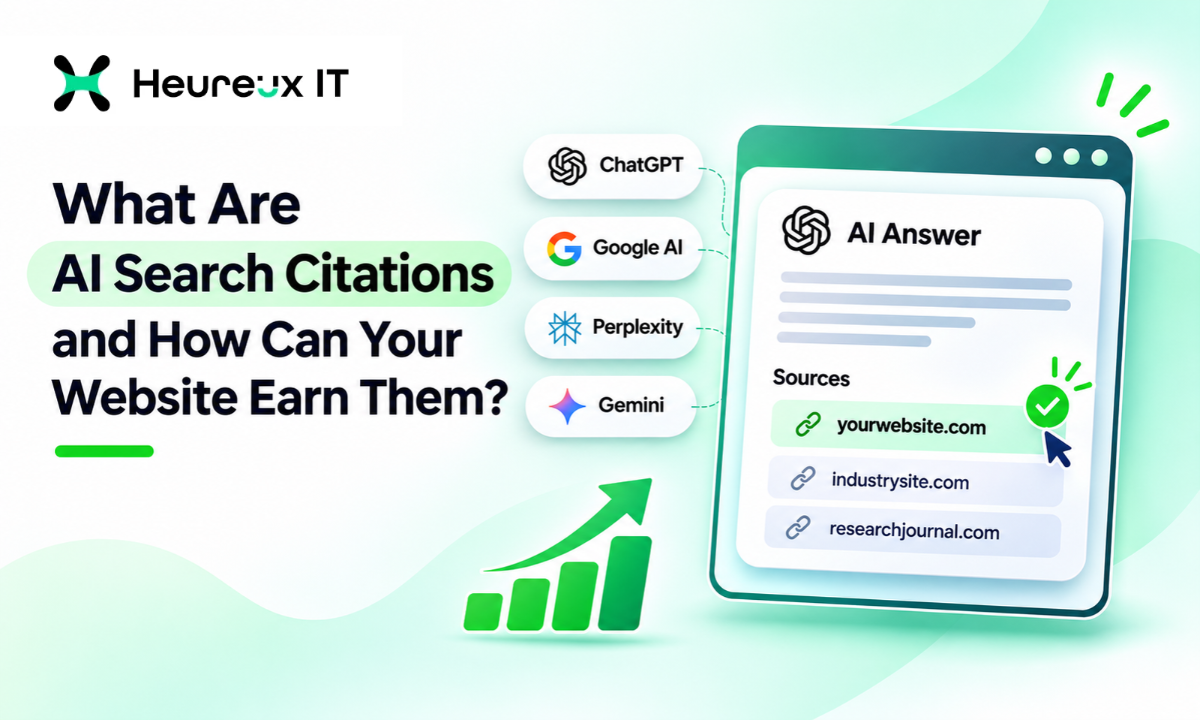
Imagine someone asks ChatGPT to recommend a reliable software platform for a small business.
Instead of showing ten traditional search results, the AI provides a direct answer comparing several options.
It explains their features, discusses their strengths, and includes links to websites supporting the information.
Now imagine one of those sources is your website.
A potential customer might discover your brand, read your information, or recognize your expertise before ever visiting your homepage.
That reference is an example of an AI Search Citation.
As tools such as ChatGPT, Google AI Overviews, Gemini, and Perplexity become part of how people research products and services, businesses have another place to earn visibility.
But appearing in AI-generated answers works differently from simply ranking for a keyword.
A website may rank well in Google without being cited in an AI answer. Another website may receive a citation because it provides a particularly relevant explanation, comparison, or piece of original research.
This creates new opportunities for businesses that produce useful content and build credible online reputations.
The challenge is knowing where to begin.
In this guide, we'll explain what AI Search Citations are, how they work, why they matter, and what your business can do to improve its chances of being referenced.
What Are AI Search Citations?
AI Search Citations are references to sources that AI-powered search tools display alongside generated answers.
These references may point to websites, articles, research papers, documentation, product pages, or other resources.
They help users identify where supporting information comes from and give them a way to explore the original source.
For example, a user might ask:
What is the difference between SEO and paid advertising?
An AI system may explain the two approaches and provide links to relevant sources.
If your digital marketing article appears as one of those sources, your website has earned an AI citation for that answer.
However, a citation doesn't mean the AI platform endorses your business or guarantees that every statement on the page is correct.
It means the platform has referenced that source within a particular response.
How AI Search Citations Work
The exact methods differ between platforms, and their full source-selection systems aren't publicly documented.
However, AI search experiences commonly use retrieval and generation processes to find relevant information and construct answers.
Simplified AI citation process
1User Question
Someone asks a question or requests a recommendation.
2
Source Retrieval
The system retrieves potentially useful information.
3
Answer Generation
Relevant information helps form an answer.
4
Source Citations
The answer may show links to supporting sources.
This is a simplified model, not a published ranking or citation-selection formula.
For Google's AI Overviews and AI Mode, Google explains that its systems can perform multiple related searches to find useful supporting pages. The final responses and links may differ between AI experiences.
A website may also inform an answer without receiving a visible citation.
That distinction matters when measuring AI search visibility.
AI Search Citations vs Traditional Backlinks
AI citations and backlinks can both help people discover useful sources, but they work differently.
| AI Search Citations | Traditional Backlinks |
|---|---|
| References displayed in AI-generated answers | Links placed on other websites |
| Depend on the specific AI query and response | Exist within published webpages |
| May change between prompts or searches | Usually remain until the linking page changes |
| Can create visibility without a click | Can send referral traffic and support SEO |
| Measured through AI responses and citation monitoring | Measured through backlink analysis tools |
One does not replace the other.
A website with useful backlinks, strong content, and good technical SEO may be better positioned for discovery across different search experiences.
Why Do AI Search Citations Matter for Businesses?
1. Increase Visibility During Customer Research
Customers often ask AI tools to explain unfamiliar products, compare services, or identify possible solutions.
A relevant citation can introduce your website during that research process.
For example, a company offering cybersecurity services might publish a guide explaining common security risks.
If an AI answer references that guide, potential customers can discover the company while learning about the problem.
2. Create Opportunities for Referral Traffic
Some AI citations include clickable links.
Users who want more detail may visit the original source.
This creates another possible traffic source alongside organic search, paid advertising, email, and social media.
However, the number of citations and resulting website visits will vary.
3. Support Brand Familiarity
Repeated exposure to a business name across relevant research topics may help users recognize it.
This is particularly useful for companies selling complex products or services with longer buying journeys.
4. Reveal Content Opportunities
Citation analysis can show which competitor pages or external publications appear in answers about your industry.
That information can help identify unanswered questions, useful content formats, and areas where your website could provide more value.
5. Add Another Dimension to SEO Measurement
Traditional SEO reports focus on metrics such as impressions, clicks, rankings, and organic conversions.
AI search introduces additional questions:
Is your brand mentioned in relevant answers? Is your website cited? Which other sources appear? Do visitors arrive from AI tools?
Measuring these patterns provides a broader view of online visibility.
Where Do AI Search Citations Come From?
AI-powered search systems may reference several types of content.
| Source Type | Examples |
|---|---|
| Business Websites | Service pages, product information, official documentation |
| Educational Content | Guides, tutorials, explanations |
| Research | Studies, original data, surveys |
| Independent Publications | News stories, industry articles, expert interviews |
| Community Discussions | Public forums and question-and-answer discussions |
| Comparison Content | Product reviews, comparisons, buying guides |
Different prompts may produce different sources.
A technical question could lead to official documentation, while a product comparison might reference reviews and product pages.
Therefore, businesses should focus on the kinds of information their customers genuinely need.
10 Practical Ways to Earn More AI Search Citations
1. Create Content That Answers Specific Questions
Start with the questions your customers ask before buying.
For example, a business owner researching digital marketing might ask:
- How does Google Ads bidding work?
- What causes a website's rankings to drop?
- How can I measure leads from paid campaigns?
- What is a reasonable website development budget?
Each question represents an opportunity to publish a useful answer.
Use clear headings and explain the main point without unnecessary introductions.
Then add details, examples, limitations, and practical steps.
The goal isn't to make every article sound like an AI answer. It's to provide information people can understand and verify.
2. Publish Original Research and Real Examples
Original information gives other sources a reason to reference your work.
A digital marketing agency might publish an analysis of campaign performance across different industries, using anonymized data where appropriate.
An Ecommerce company could publish a comparison based on actual product testing.
A software provider might share documented performance results.
Useful evidence can include original surveys, transparent calculations, product testing, or case studies.
Explain how the information was collected.
Avoid inventing statistics or presenting estimates as verified facts.
Original evidence makes an article more useful to readers and gives other publishers something specific to reference.
3. Demonstrate Experience and Expertise
Readers need to understand who is responsible for the information.
Where appropriate, identify authors, describe their relevant experience, and explain how conclusions were reached.
For technical subjects, include tested instructions and screenshots.
For service-related content, provide specific examples rather than vague promises.
A clear author biography or company information page can support transparency.
However, adding an author bio alone doesn't guarantee an AI citation.
4. Build Strong Topic Coverage
Publishing one article on a subject may leave important customer questions unanswered.
A broader collection of connected content can offer more useful explanations.
For example, a company specializing in technical SEO might cover crawling, indexing, canonical URLs, structured data, internal linking, and website migrations.
These subjects connect naturally.
Use relevant internal links to help visitors explore related information.
Avoid creating numerous near-identical articles simply to increase publishing volume.
Quality and topic relevance matter more than the number of pages.
5. Make Important Content Accessible
AI-powered search tools cannot use information they cannot access through their supported retrieval methods.
Check whether your important webpages are accessible, readable, and properly indexed where required.
Review server errors, accidental noindex directives, blocked resources, and content that only appears after difficult interactions.
For Google's AI search features, standard crawling and indexing requirements remain important.
Google specifically states that pages must be eligible to appear in Search with a snippet to qualify as supporting links in its AI features.
This makes ordinary technical SEO a useful foundation for AI visibility.
Want help turning this into results for your business?
Explore our SEO services →6. Use Clear Content Structure
Organize information with descriptive headings, paragraphs, tables, and relevant supporting examples.
For instance, an article comparing two software platforms could include their key features, differences, pricing considerations, and suitable use cases.
A reader should be able to find the answer without searching through unrelated text.
Keep important facts in accessible text, even when supporting them with images or charts.
Clear structure improves usability and can make source information easier to retrieve.
7. Implement Accurate Structured Data
Structured data can describe an organization, article, product, or other supported content.
For example, BlogPosting markup may identify an article's title, author, publication date, and publisher.
However, schema markup must describe the visible content accurately.
Google states that structured data can support eligible search features, but it does not guarantee a rich result. Google also confirms that no special structured data is required for AI Overviews or AI Mode.
Use schema where appropriate for normal SEO and content clarity, not as a shortcut to AI citations.
8. Earn Relevant Third-Party Coverage
Your website isn't the only place people can discover information about your business.
Industry publications, interviews, independent reviews, and professional resources can introduce your expertise to new audiences.
Relevant digital PR activities may include contributing expert commentary, sharing research, or collaborating on useful educational content.
Prioritize publications that serve your audience.
Avoid buying misleading endorsements or creating fabricated reviews.
9. Maintain Consistent Business Information
Make your business name, website, services, and contact details clear.
For businesses serving local customers, maintain accurate Google Business Profile information and relevant directory listings.
Avoid conflicting descriptions that could confuse customers.
Consistency is valuable for brand clarity, although there is no verified universal formula linking a particular number of mentions or reviews to AI citation frequency.
10. Monitor Citations and Improve Your Content
AI answers can change over time.
Track a consistent set of relevant questions to understand which sources appear.
Review cited pages to determine what information they provide.
Then improve your website where you can offer more complete, accurate, or original answers.
Don't copy a competitor's article simply because it receives citations.
Use the findings to identify questions your content could answer better.
How to Perform AI Citation Analysis
After improving your content, the next step is measuring where your website appears.
Similarweb's Citation Analysis framework connects cited domains and URLs to the topics and prompts where they appear. This makes it possible to study both your own visibility and the sources competitors benefit from.
Similarweb Knowledge Center
Step 1: Identify Important Customer Prompts
Create a list of questions that potential customers might ask an AI tool.
For example, a digital marketing agency could track:
- Which services help SaaS companies generate qualified leads?
- How should a small business choose an SEO agency?
- What makes a Google Ads agency reliable?
- How can an Ecommerce business improve its conversion rate?
Focus on relevant buyer questions rather than generic prompts that have little business value.
Step 2: Check AI Search Platforms
Review how relevant questions are answered in ChatGPT, Gemini, Perplexity, and Google AI search experiences.
Record which brands appear and which source URLs are cited.
Keep in mind that answers can change based on location, context, platform, and date.
Step 3: Compare Competitor Citations
Look at the specific articles and domains that appear for your target topics.
A competitor might earn citations through an original study, a detailed product comparison, or coverage in an industry publication.
Identify what makes the cited information useful.
Step 4: Improve Your Own Sources
Create or update content that answers important questions with accurate information, original evidence, and useful detail.
Prioritize the gaps that matter to your audience.
Step 5: Track Results Over Time
Repeat the analysis using a consistent prompt set and documented testing conditions.
Track citation frequency, cited URLs, brand mentions, and referral traffic.
Best Tools to Track AI Search Citations
| Tool | Useful For |
|---|---|
| Similarweb Citation Analysis | Examining cited sources, domains, URLs, topics, and prompts |
| Yoast AI Brand Insights | Monitoring brand visibility and cited sources |
| Semrush AI Visibility Tools | Reviewing AI search presence and competitors |
| Google Search Console | Monitoring Google search performance, including supported AI search reporting |
| Google Analytics 4 | Measuring identifiable referral visits from AI platforms |
| Manual Prompt Tracking | Reviewing answers and citations for selected questions |
Google has also documented a Generative AI performance report in Search Console. Use the reports available in your property to complement citation tracking rather than assuming third-party estimates equal Google's internal data.
AI Citations vs AI Brand Mentions: What Should You Measure?
Understanding What Is Generative Engine Optimization can help businesses see how citations, brand mentions, and wider AI search visibility fit together.
These two metrics are related but different.
An AI citation occurs when a response attributes information to a specific source, usually through a reference or link.
An AI brand mention occurs when an answer names a business, whether or not its website is cited.
For example, an AI response could recommend a software product while citing an independent review.
The software brand receives a mention; the review website receives the citation.
Businesses should monitor both.
| Metric | Main Question |
|---|---|
| Citation Frequency | How often is our website referenced? |
| Brand Mentions | How often does our business appear in answers? |
| Cited URLs | Which of our pages are being referenced? |
| Competitor Visibility | Which competing brands and sources appear? |
| AI Referral Traffic | How many identifiable visits arrive from AI tools? |
| AI-Attributed Conversions | What actions do those visitors complete? |
These figures should be interpreted carefully. A citation does not prove that an AI answer caused a later sale.
Common AI Citation Optimization Mistakes
One common mistake is creating generic articles that repeat existing information without adding value.
Another is treating schema markup as a guaranteed citation tool.
Businesses may also focus on publishing more pages while neglecting factual accuracy, outdated information, or website accessibility.
Some companies pursue mentions on unrelated websites solely because those sites appear in AI search results.
That approach can waste resources and damage credibility.
Finally, relying on one prompt to judge visibility can produce misleading conclusions.
AI responses vary. Reliable analysis needs consistent tracking and sufficient observations.
How Heureux IT Approaches AI Search Visibility
At Heureux IT, we believe effective AI search visibility begins with a useful website and a clear understanding of customer needs.
Our approach combines traditional SEO foundations with content planning, technical accessibility, and analysis of relevant AI search experiences.
We look at the questions customers ask, the information competing sources provide, and opportunities to publish more useful content.
That may involve improving service pages, adding original examples, strengthening topic coverage, or making information easier to access.
We also consider relevant third-party coverage and brand consistency.
The goal is not to promise citations from any particular platform. It is to improve the quality and discoverability of the information customers use to evaluate a business.
Final Thoughts
AI Search Citations are becoming another way for customers to discover information, compare solutions, and learn about businesses.
They don't replace traditional search rankings, backlinks, or website traffic.
Instead, they add another dimension to online visibility.
Businesses can improve their foundations by publishing accurate content, demonstrating relevant experience, maintaining accessible websites, and earning genuine coverage from useful external sources.
Monitoring cited URLs and brand mentions helps identify where improvement is needed.
At Heureux IT, we help businesses strengthen search visibility through SEO, content strategy, and AI search optimization.
Explore our SEO Services or read our guide to Generative Engine Optimization to learn how these approaches work together.
Frequently Asked Questions
What Are AI Search Citations? +
AI Search Citations are references to websites, articles, or other sources displayed alongside AI-generated answers.
How Can My Website Earn AI Citations? +
Publish accurate, useful content, address relevant customer questions, improve technical accessibility, and support your claims with credible evidence. No method guarantees citations.
Does ChatGPT Cite Websites? +
ChatGPT can display source references when using search or other supported retrieval features. Not every response includes citations.
Can AI Citations Improve Website Traffic? +
Yes, clickable citations can generate referral visits. However, some users may read an AI answer without visiting the source.
Are AI Citations the Same as Backlinks? +
No. Backlinks appear on webpages, while AI citations appear in generated answers and can vary between responses.
Heureux IT is a digital marketing agency specialising in Google Ads, Meta Ads and SEO. We help growing businesses turn paid and organic search into measurable revenue.